EN
EN
 AR
AR
 BG
BG
 HR
HR
 CS
CS
 DA
DA
 NL
NL
 FI
FI
 FR
FR
 DE
DE
 EL
EL
 IT
IT
 JA
JA
 KO
KO
 NO
NO
 PL
PL
 PT
PT
 RO
RO
 RU
RU
 ES
ES
 SV
SV
 TL
TL
 ID
ID
 LT
LT
 SR
SR
 SK
SK
 SL
SL
 VI
VI
 HU
HU
 TH
TH
 TR
TR
 FA
FA
 MS
MS
 BE
BE
 IS
IS
 AZ
AZ
 BN
BN
 EO
EO
 LA
LA
 MN
MN


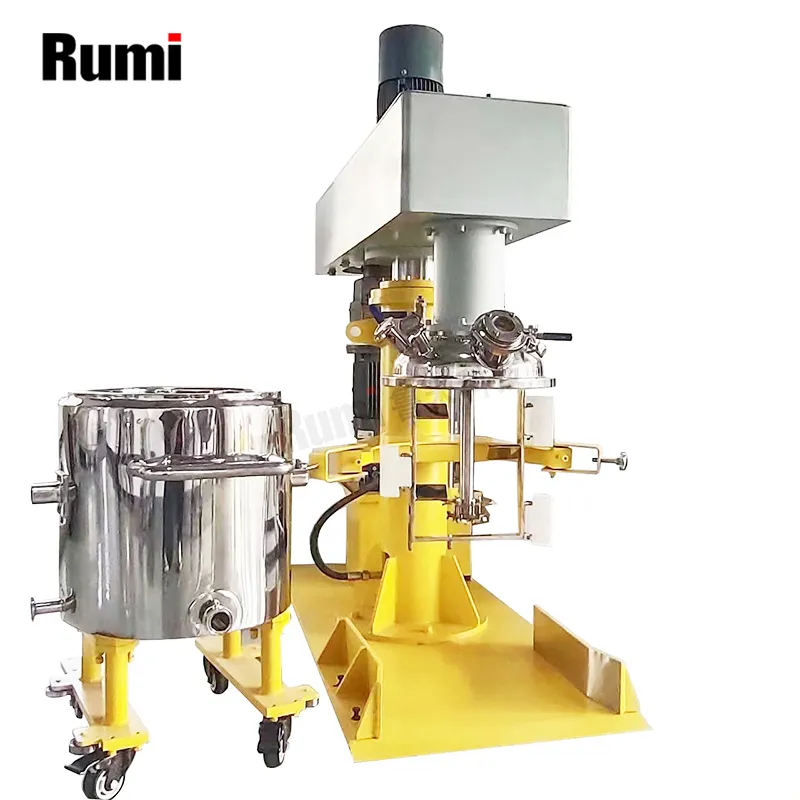
In most manufacturing industries, dispersion and homogenous mixing is a necessity in ensuring that there is product quality. Strong shear forces are frequently needed in industries, including coatings, inks, adhesives, and chemical materials, to disperse the agglomerates of the particles and to evenly distribute the solids in the liquid formulations. In such applications, the use of double shaft dispersing mixers has proved to be a viable and commonplace solution.
This kind of mixer will be appropriate in the processes that need both shear force and stable bulk mixing by incorporating high speed dispersion and effective circulation of the material. Knowledge of the mechanism and operation of these mixers as well as their effectiveness in high shear facilities could enable producers to select appropriate equipment to suit their production requirements.
Learning about High-Shear Mixing Requirements
High-shear mixing is usually necessary when solids are to be dispersed to liquid systems. Pigments, fillers, powders, and other additives would normally form clusters as they are added to liquids. The clusters can be left partially suspended without the necessary shear force resulting in poor consistency of the products.
In high-shear processes, it is necessary to have a device that can produce strong mechanical forces that can disperse agglomerates and uniformly distribute particles. Meanwhile, the material should flow well inside the mixing vessel in order to subject all parts of the batch to the shear zone. It is in this regard of high dispersion and continuous circulation that the strong dispersion of continuous circulation offers the benefit of the double shaft dispersing mixer.
The Dual-Shaft Efficient Mixing Design
The distinguishing characteristic of a double shaft dispersing mixer is that it has two shafts which are independent of each other as each has a different mixing role. The former shaft is high-speed and has a dispersing disc on it. This element produces powerful shear forces that assist in disintegrating particles and dispersing powders to the liquid phase. The high speed rotation generates turbulence and localized energy which promotes efficient particle size reduction and dispersion.
The second shaft has a lower speed and would normally have an anchor or a different form of agitator. It plays the main task of transporting materials through the vessel which ensures that every section of the mixture is constantly in movement. Since the two shafts work in tandem, the mixer offers high shear as well as full-batch mixing and thus is more efficient in overall processing than in the single-shaft systems.
Better Randomization of Complex Formulae
Various industrial formulations would have numerous components with varying physical characteristics. Included in the examples are resins, solvents, pigments, fillers and performance additives found in the coatings and adhesives. All these materials should be well incorporated so as to get the final desired properties.
An example of such complex formulations is the use of the double shaft dispersing mixers to control the distribution of these powders in order to wet them and dispersing them as soon as possible whilst the bulk material is in movement. Constant circulation enables the vessel bottom materials and vessel side materials to be transported to the high-shear zone to enhance uniformity in dispersion throughout the entire batch. The ability of the equipment renders it to be highly applicable in processes that are capable of solid liquid mixing with medium to high viscosity materials.
Adaptability to other Industrial uses
The next benefit of the double shaft dispersing mixers is their flexibility. Most of these production plants need equipment that would be able to adjust to various formulations, batch sizes, and processing conditions.
These mixers can be combined with varying vessel size and mixing tools depending on the needs of the production. Other additions like heating or cooling jackets, variable speed control or incorporations with the other processing equipment can also be added. In most instances, double shaft dispersing mixers have been combined with larger production systems along with mills, reactors, and storage tanks to produce the efficient processing works.
In defending Continuous Factory Production
In high-shear processes, sustainable mixing performance is crucial to the quality of the product. The equipment which gives high dispersion and consistent material transport can also be used to ensure that every batch will be subjected to similar conditions. The objective is facilitated by double shaft dispersing mixers which incorporate varying mixing mechanisms in one system. The high speed disperser lays emphasis on the dispersion of particles whereas the low speed agitator ensures the overall circulation. This combined mix method enhances process stability and ensures that the possibility of uneven mix is minimized.
In the case of industries handling pigment dispersions, adhesives and similar substances, proper choice of mixing equipment is a major factor in ensuring an efficient and reliable production.
Conclusion
The dispersing mixers have double shafts, which are good in industrial processes that need a high level of shear and good circulation of material. They have a dual-shaft design enabling them to integrate effective dispersing with continuous bulk mixing, which makes them effective in working with complex formulations and medium and high viscosity materials. With manufacturing processes that are more and more efficient in need, and the products that require uniform quality, equipment that assists in the productive dispersion and mixing will not be disregarded. The double shaft dispersing mixers offer an equal approach to most of the high-shear applications in the current industrial production.