 en
en  vi
vi  it
it  es
es  tr
tr  ja
ja  pt
pt  nl
nl  ru
ru  fr
fr  de
de  pl
pl  ar
ar News
Latest news and events.



High-viscosity materials behave very differently from low-viscosity liquids during mixing. Adhesives, sealants, silicone, resins, battery materials, electronic compounds, and other thick formulations can move slowly inside a vessel and create considerable resistance against the agitator. With a conventional mixer, this can result in poor circulation, unmixed areas, powder agglomeration, material sticking to the vessel wall, and significantly longer mixing cycles.
For manufacturers, the challenge is not simply achieving a higher mixing speed. The mixer must generate enough torque to move the material, provide the right agitator geometry for circulation and dispersion, and maintain appropriate temperature and process conditions. This makes the selection of a Small high viscosity mixing machine manufacturer just as important as choosing the equipment itself, particularly when the mixer will be used for formulation development, small-batch production, or pilot-scale manufacturing.
A high viscosity mixing machine is primarily designed around the relationship between material resistance and mechanical force. As viscosity increases, the agitator requires more torque to maintain movement, especially during startup or when the formulation contains a high concentration of powders or fillers.
A high-torque drive allows the mixer to operate at controlled speeds without excessive mechanical loading. This is often more useful than simply installing a high-speed motor. For highly viscous materials, the process may require relatively low rotational speed but substantial torque to maintain bulk circulation.
The agitator itself is equally important. Anchor agitators can provide strong bulk movement and improve contact with the vessel wall, while planetary systems move through different areas of the batch and can be effective when natural circulation is limited. High-shear dispersing elements are more suitable when pigments, powders, fillers, or other solid particles need to be rapidly incorporated and dispersed.
Therefore, high viscosity mixing equipment should be configured according to the actual mixing mechanism required rather than selected solely by motor power or vessel volume.
Torque is one of the most important specifications when evaluating equipment for thick materials. A mixer may operate successfully with a low-viscosity liquid at high speed but become overloaded when the same vessel is filled with a resin, sealant, or silicone compound.
The required torque depends on several factors, including material viscosity, batch volume, solids content, agitator geometry, rotational speed, and temperature. Startup torque can also be substantially higher than the torque required after the material begins moving.
This is why buyers should ask manufacturers for actual torque information rather than evaluating motors only by rated power. A suitable drive system should maintain stable operation throughout the mixing cycle without excessive heating, vibration, or overload.
For process engineers, the practical objective is to find a combination of torque and speed that produces sufficient material movement while avoiding unnecessary shear and heat generation.
The wrong agitator can limit mixing performance even when the drive system has sufficient power.
Anchor-style agitators are often useful for high-viscosity formulations because their geometry promotes bulk movement and can sweep material close to the vessel wall. Adding a scraper system can further reduce wall accumulation and improve heat transfer through the vessel jacket.
Planetary mixing provides another approach. Instead of rotating around a fixed central position only, the agitator travels through the vessel while rotating, exposing different portions of the batch to the mixing zone. This can help reduce stagnant areas when the material has poor natural flow.
For formulations containing powders or pigments, a high-shear disperser may be integrated with the primary mixing system. The bulk agitator moves the overall material mass, while the dispersing element provides localized shear where particle breakdown and wetting are required.
The best configuration depends on whether the process prioritizes bulk mixing, powder incorporation, dispersion, wall scraping, deaeration, or several of these functions simultaneously.
Vacuum capability is valuable when air entrainment affects the final product. Adhesives, sealants, silicone compounds, and resin formulations can trap air during powder addition and mixing. If the finished product must have low void content or a consistent appearance, vacuum mixing can help remove entrained air.
However, vacuum should not automatically be treated as a mandatory specification. The need depends on the formulation, solids loading, mixing method, and final product requirements.
Temperature control is similarly important. High-viscosity materials can become significantly harder to process when their temperature falls, increasing the torque requirement. At the same time, excessive shear can generate heat that may affect temperature-sensitive formulations.
A jacketed vessel with heating or cooling capability allows the process engineer to maintain a more controlled operating range. Combined with wall scraping, it can also improve heat transfer when the material is too viscous for efficient natural circulation.
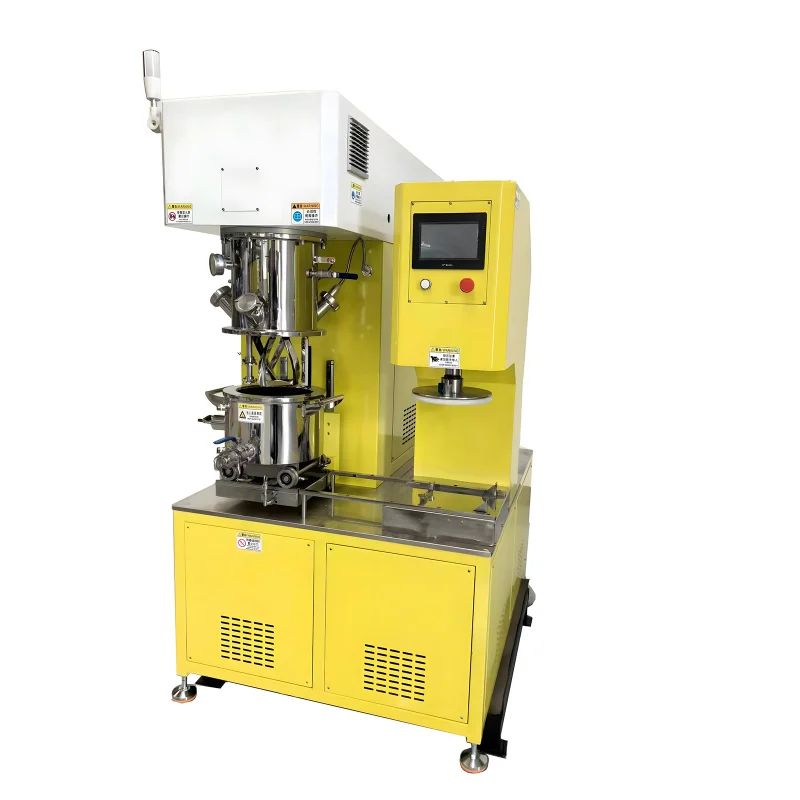
A Small high viscosity mixing machine is particularly useful for laboratories, formulation development, pilot production, and small-batch manufacturing.
Laboratory teams may need to test a new adhesive or resin formulation using only a few kilograms of material. A small manufacturer may produce limited batches of silicone sealant or electronic compounds. In both cases, using a large industrial mixer can increase equipment cost, floor-space requirements, cleaning time, and material consumption.
A compact mixer can provide greater process flexibility while still incorporating high-torque drives, variable-speed control, vacuum systems, heating or cooling, and specialized agitators.
However, “small” should refer to capacity and footprint rather than simplified engineering. A small batch of highly viscous material can still require substantial torque. Equipment selection should therefore consider actual working volume, minimum batch size, viscosity, solids content, required mixing time, and formulation behavior.
Material viscosity is only one part of the selection process. Batch size and mixing time must also be considered.
For example, a 10-liter batch of a very thick compound may require a different drive and agitator configuration from a 10-liter liquid formulation with low viscosity. Similarly, if the process requires several mixing stages, the machine may need variable-speed control so that low-speed bulk movement can be combined with higher-speed dispersion when necessary.
Dead zones should also be evaluated. Areas around the vessel wall, bottom, corners, or shaft can retain material if the agitator does not generate sufficient circulation. Scrapers, anchor structures, or planetary movement can be used to address these problems depending on the formulation.
Cleaning should not be overlooked. For adhesive, silicone, resin, and sealant applications, residual material can make product changeover difficult. Accessible components, appropriate vessel geometry, suitable surface finishing, and practical agitator removal can significantly affect maintenance time.
The main difference between small and industrial systems is not simply capacity.
Small high viscosity mixing machines generally prioritize flexibility, compact dimensions, small working volumes, formulation testing, and convenient cleaning. They are well suited to R&D and small-batch production where recipes may change frequently.
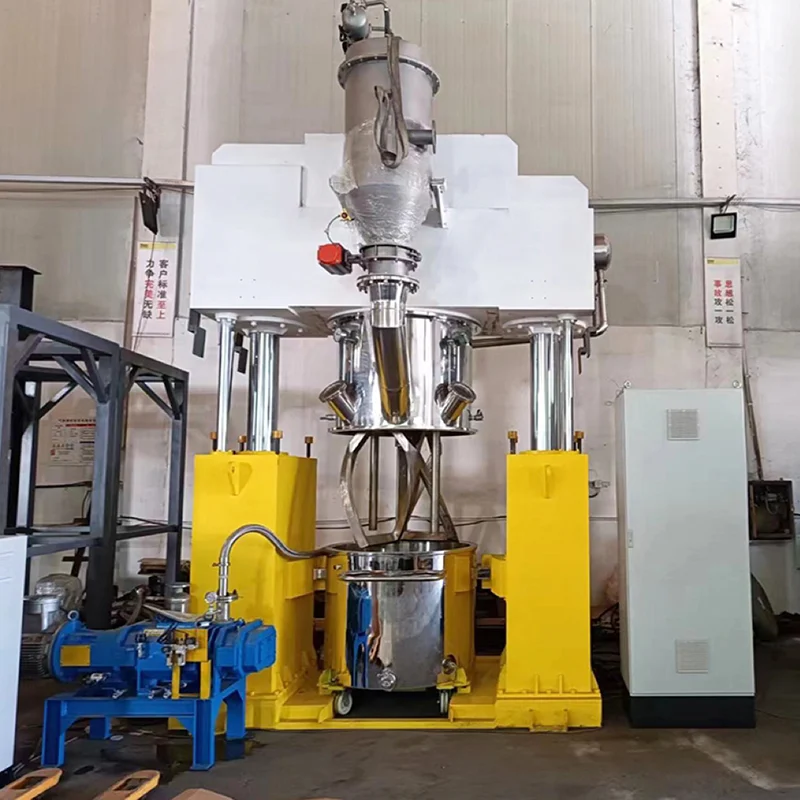
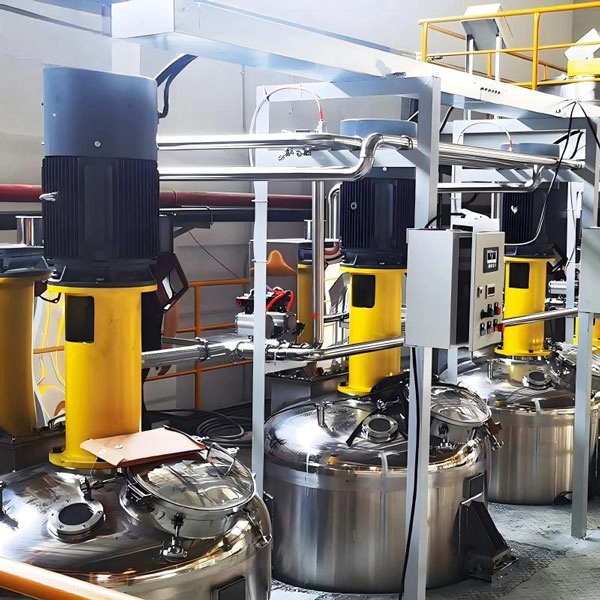
Industrial high viscosity mixing equipment must usually support larger batch sizes, longer operating cycles, higher continuous mechanical loads, and more integrated process control. These systems may require larger torque reserves, more robust drive systems, automated feeding, vacuum control, heating and cooling systems, and more sophisticated monitoring.
The correct choice depends on the production stage. A laboratory developing a silicone formulation may prioritize flexibility and precise process adjustment, while an industrial sealant manufacturer may place greater emphasis on continuous torque capacity, thermal control, vacuum performance, automation, and long-term mechanical stability.
A reliable manufacturer should be able to connect equipment specifications with actual process requirements.
Buyers should examine working capacity, practical viscosity range, drive torque, agitator type, scraper configuration, speed range, vacuum capability, heating and cooling performance, contact material, automation level, and cleaning requirements.
More importantly, the supplier should be able to explain why a particular configuration is suitable for the material. If a manufacturer only provides a standard vessel and motor without discussing viscosity, batch size, solids loading, mixing time, and agitator geometry, its ability to solve complex high-viscosity applications may be limited.
Testing capability is another important consideration. Pilot testing with the actual formulation can reveal whether the selected agitator produces adequate circulation, whether powders disperse properly, how much torque is required, and whether temperature remains within the desired range.
RUMI Technology is a professional supplier focused on chemical equipment and solutions, serving global customers with reliable products, strict quality control, and efficient service.
Since launching its first self-developed high-precision dosing system and high-efficiency mixing equipment in 2018, RUMI Technology has focused on becoming a professional fine chemical equipment service provider. Its development has included hundreds of R&D iterations and the establishment of proprietary technical capabilities supported by invention patents.
RUMI has developed customized solutions for paint and ink manufacturers requiring accurate dosing, resin and new-material companies requiring high-efficiency mixing, and customers in the new energy and composites industries. This process-oriented experience is particularly relevant when standard mixing equipment cannot adequately address a customer's material characteristics.
Its quality assurance system includes 72-hour factory testing and a 24-hour after-sales response, supported by ISO9001 and CE certifications. These capabilities allow RUMI to approach mixing equipment not simply as a standalone machine, but as part of a complete material-processing solution.
The most suitable high viscosity mixing equipment is not necessarily the machine with the highest speed, largest motor, or greatest capacity. The critical question is whether the equipment can maintain the required mixing mechanism under the actual material viscosity, batch size, solids content, temperature, and processing time.
For small-scale production and formulation development, a Small high viscosity mixing machine can provide the necessary torque and mixing performance while reducing space requirements and improving process flexibility. For industrial manufacturing, a larger customized system may be justified when production volume, continuous operation, automation, and thermal or vacuum control become more demanding.
Ultimately, the right Small high viscosity mixing machine manufacturer should be capable of translating material characteristics and process requirements into a practical equipment configuration. That means understanding torque, agitator geometry, circulation, dispersion, temperature, vacuum, capacity, and maintenance as interconnected factors—not isolated specifications. This process-based approach gives B2B buyers a much more reliable basis for selecting equipment that can perform consistently from laboratory trials through industrial-scale production.