 en
en  vi
vi  it
it  es
es  tr
tr  ja
ja  pt
pt  nl
nl  ru
ru  fr
fr  de
de  pl
pl  ar
ar News
Latest news and events.



High-viscosity materials expose the limitations of conventional mixing equipment quickly. As viscosity rises, the material becomes harder to circulate through the vessel, heat transfer slows down, and conventional agitators can leave unmixed zones around the vessel wall. Entrapped air is another concern: aggressive mixing may introduce bubbles while insufficient shear leaves powders, fillers, or additives poorly dispersed. For manufacturers of battery slurry, silicone, sealants, adhesives, ceramic paste, and other viscous formulations, the mixer therefore needs to control several variables at the same time rather than simply rotate an agitator.
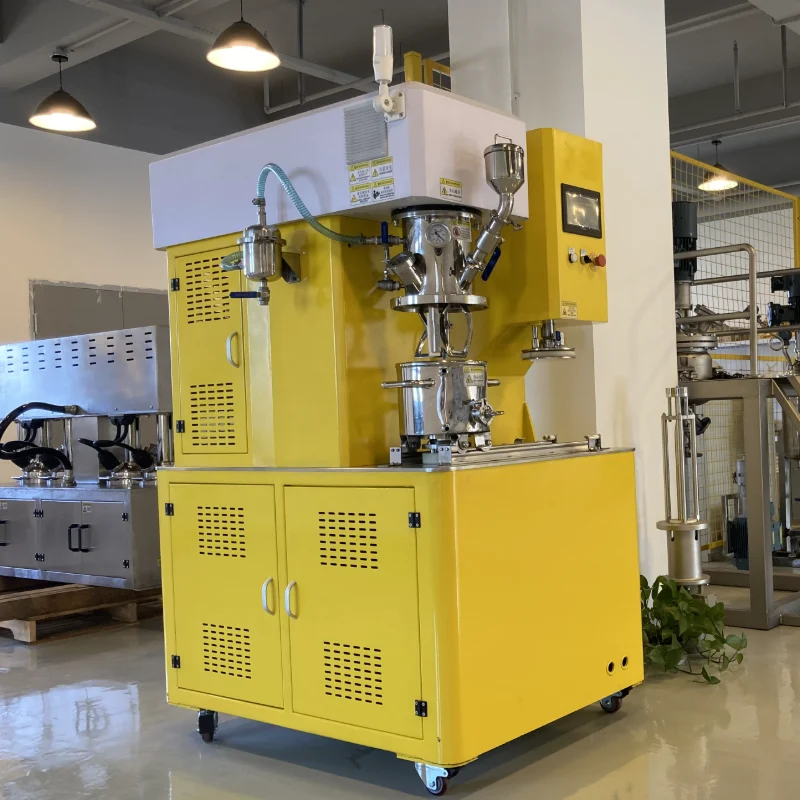
A planetary vacuum mixer addresses this problem through the coordinated movement of planetary paddles, a high-speed disperser, a PTFE wall scraper, vacuum equipment, and a jacketed vessel. The result is a mixing process designed around material circulation, dispersion, deaeration, and temperature management.
The key difference is the movement of the mixing tools. In a planetary configuration, the double planetary paddles rotate around their own shafts while simultaneously revolving around the center of the mixing vessel. This creates continuous movement through different areas of a high-viscosity mass instead of relying on a single rotational flow pattern.
As the paddles move, they push material toward the working zone of the high-speed dispersing disc. The disperser introduces higher localized shear, which is particularly useful when powders, pigments, fillers, or other solid components must be incorporated into a viscous base. The planetary paddles provide bulk mixing, while the high-speed disperser addresses localized dispersion. Using the two functions together is more effective than expecting one agitator to perform both tasks equally well.
The PTFE wall scraper completes the circulation pattern. It continuously removes material from the interior wall and returns it to the active mixing zone. This reduces wall buildup and dead zones, while also helping minimize residual material left in the vessel after a batch.
For very viscous formulations, this mechanical combination is important because simply increasing rotational speed does not necessarily improve mixing. Excessive speed can increase heat generation or entrain air. A better approach is to select the appropriate paddle movement and dispersing intensity for the formulation.
Vacuum is not merely an additional operating feature. It directly changes the environment in which mixing takes place.
During conventional atmospheric mixing, air can become trapped between viscous material layers or introduced through surface turbulence. Because highly viscous materials do not release entrained air easily, these bubbles may remain in the finished product. Under vacuum, the reduced pressure promotes the expansion and removal of entrapped gas from the mixture.
At the same time, maintaining a vacuum environment reduces direct contact between the material and atmospheric oxygen. This can be valuable for formulations whose quality or stability may be affected by oxidation. The actual vacuum level and duration should be established according to the material's viscosity, volatility, formulation chemistry, and process requirements rather than applying one fixed setting to every product.
For operators following a Planetary Vacuum Mixer Manual, a practical sequence is generally to load the formulation according to its process specification, establish an appropriate initial mixing speed, introduce vacuum progressively, monitor the mixture, and adjust mixing, dispersion, temperature, and vacuum conditions according to batch behavior. The manual should be treated as the operating reference for the specific machine rather than as a substitute for formulation validation.
The two systems have different jobs. Double planetary paddles provide large-scale material turnover and help move the entire viscous mass through the vessel. The high-speed disperser produces localized shear to break down agglomerates and distribute fine solids more uniformly.
This combination is particularly relevant to lithium battery slurry, solder paste, ceramic paste, pigments, fillers, and other formulations where dispersion quality can directly affect downstream performance.
The operating strategy should not be based on maximum speed. A process engineer may use relatively controlled planetary mixing for bulk incorporation, followed by higher dispersing intensity when the formulation requires stronger shear. The appropriate sequence depends on powder loading, viscosity development, particle size, temperature sensitivity, and the formulation's rheological behavior.
High viscosity also creates a thermal challenge. As viscosity increases, mechanical resistance rises and the material can become difficult to circulate. At the same time, viscous mixing can generate heat, while some formulations must remain within a relatively narrow processing-temperature range.
A jacketed mixing vessel allows heating or cooling media to circulate around the vessel. Heating can reduce viscosity and make difficult materials easier to process, while cooling can remove process heat and protect temperature-sensitive formulations. For example, a formulation may become significantly easier to mix after controlled heating, while a heat-sensitive adhesive may require cooling to prevent excessive temperature rise.
Temperature should therefore be treated as part of the mixing process rather than an independent utility. Coordinating temperature with paddle speed, dispersion intensity, and vacuum conditions can improve batch-to-batch consistency.
Planetary vacuum mixers are particularly suited to high-viscosity formulations that require intensive mixing, dispersion, or deaeration. Typical applications include lithium battery slurry, silicone gel, sealants, structural adhesives, solder paste, ceramic paste, putty, toothpaste, soft creams, and other viscous pastes.
The exact usable viscosity range cannot be determined from mixer capacity alone. Material rheology, solids content, formulation temperature, batch size, and paddle geometry all influence the required drive torque and mixing performance. Buyers should therefore provide actual formulation data when specifying equipment instead of selecting a machine solely from a nominal volume rating.
Capacity is the first selection factor, but it should not be considered in isolation. Rumi's planetary vacuum mixer range covers approximately 30L to 2000L, allowing equipment selection according to laboratory, pilot, and production requirements. The useful working volume should be considered alongside headspace requirements, vacuum operation, material expansion, and the actual batch size.
Paddle configuration is equally important. For high-viscosity products, the combination of double planetary paddles + high-speed disperser + PTFE wall scraper provides a broader process capability than a basic single-agitator design.
Speed control is another key consideration. Frequency-converter control allows operators to adjust rotational speed according to different stages of the formulation. Vacuum capability should be evaluated together with vessel sealing, vacuum stability, and the actual deaeration requirements of the material.
Material construction also affects service life. SUS304 is suitable for many industrial formulations, while 316L stainless steel can be selected when greater corrosion resistance or more demanding material-contact requirements justify it.
For production equipment, hydraulic lifting, safety limit switches, and PLC touchscreen control are not simply convenience features. Hydraulic lifting allows the vessel or mixing head to move into the required operating position, while safety interlocks prevent operation when the vessel or agitators are not correctly positioned. The PLC interface provides centralized control of speed, temperature, lifting, and related operating functions, making repeatable batch procedures easier to implement.
For a buyer comparing the Best planetary vacuum mixer, the most useful comparison is not which machine has the highest motor power or maximum speed. The better question is whether the complete system matches the material and production process.
A battery-material manufacturer may prioritize controlled dispersion and vacuum deaeration. A sealant producer may place greater emphasis on high-torque planetary mixing and temperature management. A ceramic paste manufacturer may require strong dispersion and corrosion-resistant wetted parts. A toothpaste or personal-care manufacturer may place greater weight on sanitary construction, temperature control, and repeatable batch operation.
Rumi Technology approaches these requirements as a fine chemical equipment supplier rather than treating the mixer as a standalone mechanical product. Since developing its first self-developed high-precision dosing system and high-efficiency mixing equipment in 2018, RUMI Technology has focused on customized equipment and process solutions for coatings, inks, resins, new materials, new energy, and composite applications. Its quality system includes 72-hour factory testing and 24-hour after-sales response, with ISO9001 and CE certifications supporting its equipment quality framework.
For high-viscosity production, the practical value of a planetary vacuum mixer comes from how these systems work together. Planetary paddles provide full material turnover, the disperser supplies localized shear, the PTFE scraper reduces wall accumulation, vacuum removes entrained air, and the jacket manages process temperature. When these functions are correctly matched to the formulation, manufacturers can obtain more consistent mixing and dispersion while reducing problems associated with bubbles, dead zones, and uncontrolled temperature rise.
For this reason, the Planetary Vacuum Mixer Manual should be viewed as part of a broader process-control strategy, while selecting the Best planetary vacuum mixer should begin with the material's rheology, batch size, dispersion requirements, vacuum sensitivity, temperature window, and expected production duty. This process-based approach provides a more reliable basis for equipment selection than comparing headline specifications alone.