 en
en  vi
vi  it
it  es
es  tr
tr  ja
ja  pt
pt  nl
nl  ru
ru  fr
fr  de
de  pl
pl  ar
ar News
Latest news and events.




When processing high-viscosity materials, a conventional single-shaft mixer can reach its limits quickly. As viscosity increases, the material becomes less willing to circulate through the vessel. The result can be incomplete dispersion, stagnant zones, material adhering to the tank wall, and poor heat transfer between the product and jacket. Simply increasing the motor power or agitator speed does not always solve these problems; excessive speed can increase energy consumption, introduce air, or create localized shear without establishing sufficient bulk circulation.
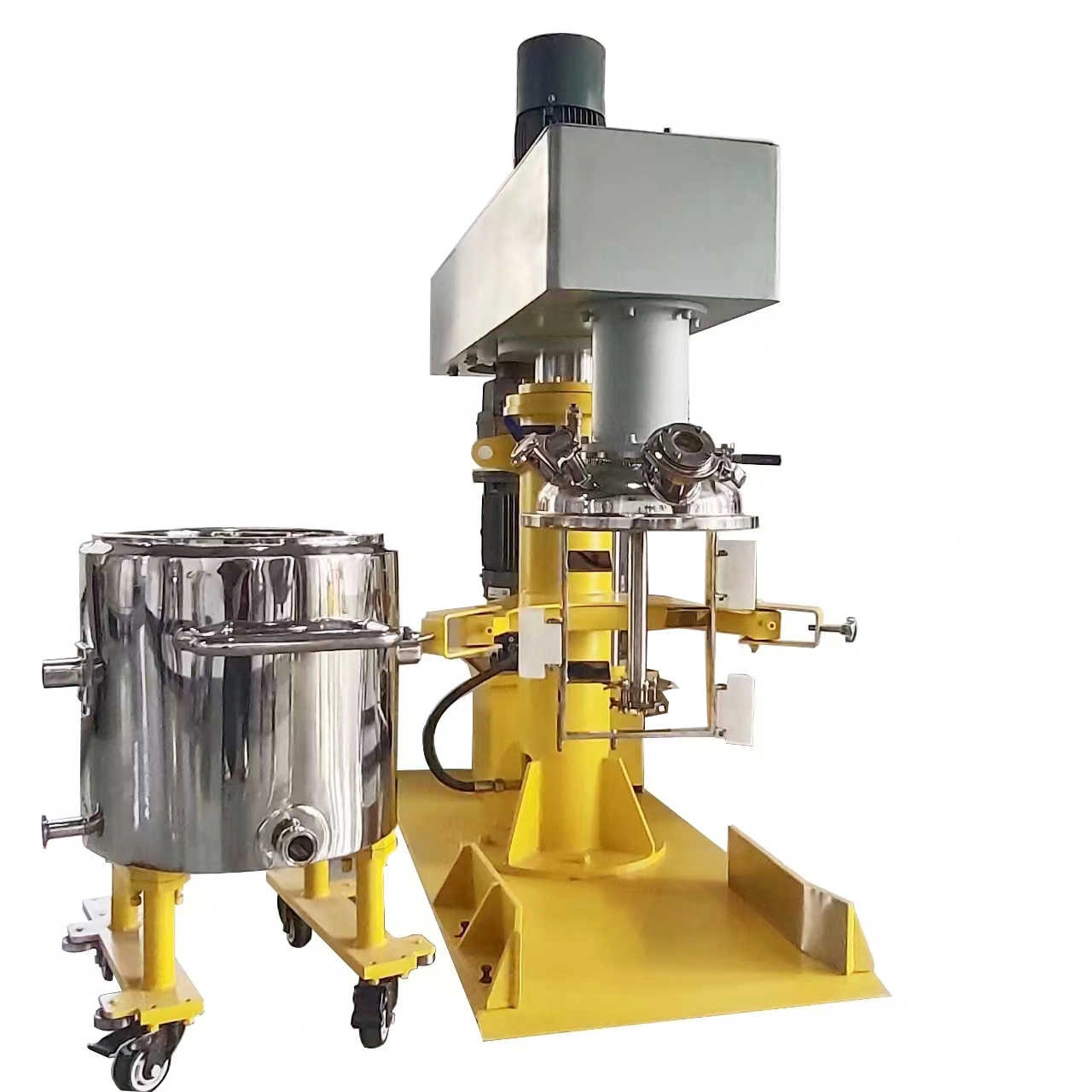
An industrial triple shaft mixer addresses these challenges by assigning different mixing functions to three independently driven agitators. A high-speed dispersing disc provides localized shear, a low-speed helical blade promotes axial movement and bulk circulation, while an anchor blade equipped with a wall scraper continuously moves material away from the vessel wall. This combination is particularly useful when one batch must perform several operations—blending, dispersion, circulation and wall scraping—without transferring the material between machines.
For chemical processors, ink manufacturers, adhesive producers and other companies working with viscous formulations, the key question is therefore not simply whether a mixer is powerful enough. It is whether the machine's shaft configuration, blade geometry, speed range, temperature control and vessel design match the actual rheology and process sequence.
The defining characteristic of a triple shaft mixer is functional separation. Instead of asking one agitator to perform every mixing task, three independently controlled shafts can generate different flow and shear conditions inside the same vessel.
The high-speed disperser is primarily responsible for localized high shear. Its dispersing disc creates strong velocity gradients around the disc, helping break down agglomerates and distribute powders, pigments, fillers or other solid components throughout the liquid or semi-solid phase. A lifting mechanism can also allow the dispersing disc to move vertically while rotating, extending its effective working zone and reducing the possibility of repeatedly processing only one region of the batch.
The helical blade operates at a much lower speed and performs a different job. Rather than relying mainly on intense localized shear, it moves the viscous mass through the vessel, encouraging material from different levels to circulate and exchange positions. This bulk movement becomes increasingly important as viscosity rises because natural convection and fluid circulation become weaker.
The third element is the anchor blade with wall scraper. Its geometry follows the vessel contour, while the scraper continuously sweeps material from the inner wall. This has two consequences. First, material that would otherwise remain stagnant near the wall is returned to the active mixing zone. Second, removing the relatively stationary boundary layer improves heat transfer between the product and the jacket.
The three actions therefore complement rather than duplicate each other:
| Mixing element | Primary function | Typical contribution |
|---|---|---|
| High-speed dispersing disc | High shear | Pigment, powder and agglomerate dispersion |
| Helical blade | Bulk circulation | Axial movement and overall blending |
| Anchor + wall scraper | Wall movement | Reduced dead zones and improved heat exchange |
This is why a well-configured triple shaft mixer can be more useful than simply installing a larger single agitator. The objective is to create different flow mechanisms simultaneously.
There is no universal blade arrangement that is optimal for every formulation. Industrial triple shaft mixer manufacturers typically configure the mixing system according to viscosity, solids loading, dispersion requirements, temperature sensitivity and the desired production sequence.
A common configuration is:
High-speed dispersing disc + helical blade + anchor blade with scraper
This arrangement is well suited to formulations requiring both strong dispersion and substantial bulk movement. The dispersing disc handles localized high-shear work, while the helical and anchor blades keep the viscous mass moving through the vessel.
For formulations requiring more intensive homogenization, another option is:
High-speed disperser + homogenizer + anchor blade with scraper
The homogenizer introduces another high-shear mechanism, making this configuration more appropriate when particle size reduction, emulsification or finer structural uniformity is a major process objective.
Other arrangements can include:
Two high-speed dispersers + anchor blade with scraper
This can be considered when the formulation contains a significant amount of difficult-to-disperse powders or requires stronger dispersion capacity.
A further configuration is:
High-speed disperser + rotor/stator + anchor blade with scraper
The rotor/stator system can provide concentrated shear in applications where conventional disc dispersion alone may not deliver the required level of refinement.
The important point for procurement is that the number of shafts alone does not determine mixing performance. Blade geometry, shaft speed, working volume and the relationship between the different agitators must be evaluated as a complete system.
The application range of a triple shaft mixer comes from its ability to combine high shear with controlled bulk circulation.
Ink formulations often contain pigments, resins, solvents and additives that must be dispersed consistently. A high-speed dispersing disc can break up pigment agglomerates, while the slower blades maintain circulation through the vessel. Wall scraping is especially useful when resin-rich material tends to accumulate around the tank perimeter.
Sealants and adhesives can become highly resistant to movement as viscosity increases. A single high-speed agitator may create a strongly sheared region around the blade while leaving other material relatively inactive. The helical and anchor systems help extend movement beyond this localized zone.
For adhesive production, vacuum capability can also become important when entrained air must be minimized before filling or subsequent application.
Temperature is a process variable rather than merely a convenience. Hot melt systems require controlled heating to maintain processable viscosity. A jacketed vessel can provide heating during melting and controlled cooling during later stages, depending on the formulation and production sequence.
Magnetic slurry formulations can contain solid particles that require consistent dispersion without allowing excessive settling or localized accumulation. The combination of high-shear dispersion and low-speed bulk movement allows the equipment to address both dispersion and overall batch circulation.
These materials often combine high viscosity with sensitivity to air incorporation, temperature and texture. Depending on formulation requirements, homogenization, vacuum processing and jacket temperature control may be more important than simply increasing agitator speed.
One of the most important differences between a triple shaft mixer and a conventional single- or double-shaft machine is independent control of the three agitators.
The operator can adjust each shaft according to its function rather than forcing every agitator to operate at the same speed.
For example, a process may require:
High-speed dispersion during powder incorporation
Lower-speed helical circulation during bulk blending
Continuous anchor scraping throughout the batch
Reduced disperser speed during temperature-sensitive stages
Frequency converter control makes these adjustments practical. Instead of defining the machine by one fixed rotational speed, the mixer can be operated across different process stages.
This is particularly valuable when the viscosity of the material changes during production. A resin may become progressively thicker as solids are incorporated, while a hot melt adhesive may show significantly different flow behavior before and after heating.
The advantage of three independent agitators is therefore process control, not simply having three shafts inside the vessel.
High-viscosity mixing often generates heat through mechanical shear. At the same time, some formulations require external heating to reduce viscosity and improve mixing. Others must be cooled to prevent thermal degradation.
A jacketed mixing tank allows heating or cooling through a heater or chiller. The anchor scraper contributes by continuously refreshing the material layer adjacent to the vessel wall, improving the contact between the product and the temperature-controlled surface.
Vacuum capability becomes relevant when air removal is part of the process. Adhesives, sealants, creams and other viscous products can retain air because bubbles have difficulty escaping through a dense material. Vacuum processing can help remove entrained air and improve the consistency of the finished batch.
For oxidation-sensitive formulations, an inert-gas atmosphere may be preferable. The choice between vacuum and inert-gas protection should be based on formulation chemistry and process requirements rather than treated as a standard feature for every application.
Material selection also matters. SUS304 can be suitable for many general industrial formulations, while 316L stainless steel offers higher corrosion resistance and is often preferred when the formulation, cleaning process or chemical environment requires it.
Price should not be the first specification used to compare machines. For a high-viscosity process, the following parameters are more useful.
1. Blade configuration: Confirm whether the machine uses a dispersing disc, helical blade, anchor scraper, homogenizer or rotor/stator system—and understand why that combination fits the formulation.
2. Working capacity: Distinguish between total vessel volume and effective working volume. A mixer that is too large or too small for the actual batch can negatively affect mixing performance.
3. Viscosity range: Do not provide viscosity as an isolated number. The supplier should understand the material's viscosity during different process stages, including powder addition, heating and final formulation.
4. Independent drive control: Check whether all three shafts can be controlled independently and whether frequency conversion is available.
5. Vacuum capability: Verify the required vacuum level, sealing configuration and whether the vessel is designed for vacuum operation.
6. Heating and cooling: Examine jacket design, heating medium, cooling method and temperature-control requirements.
7. Wetted materials: Select SUS304 or 316L according to chemical compatibility, cleaning requirements and production conditions.
8. Customization: For unusual rheology or complex formulations, blade configuration and shaft arrangement should be engineered around the process rather than selected from a standard catalog.
The best machine is not necessarily the one with the highest motor power. It should provide sufficient torque and effective circulation while matching the material's viscosity, solids content, shear sensitivity and temperature requirements. For many high-viscosity formulations, the combination of high-speed dispersion, low-speed helical circulation and anchor scraping provides a more balanced process.
Three independently driven agitators perform different functions within the same vessel. The disperser generates high shear, the helical blade promotes bulk circulation, and the anchor blade with scraper moves material along the vessel wall and improves heat exchange.
Independent drives allow the operator to change the intensity and role of each mixing mechanism. This provides greater flexibility when the material changes from a low-viscosity starting phase to a much thicker final formulation.
Evaluate the manufacturer's ability to match blade geometry, drive systems, vessel volume, vacuum, temperature control and material construction to the actual process. Engineering capability and testing are often more important than catalog capacity alone.
Yes. The configuration is particularly suitable when the formulation requires a combination of high-shear dispersion, bulk circulation and continuous wall scraping. Adhesives may additionally benefit from vacuum and temperature control, while printing inks often require careful disperser selection and control of pigment dispersion.
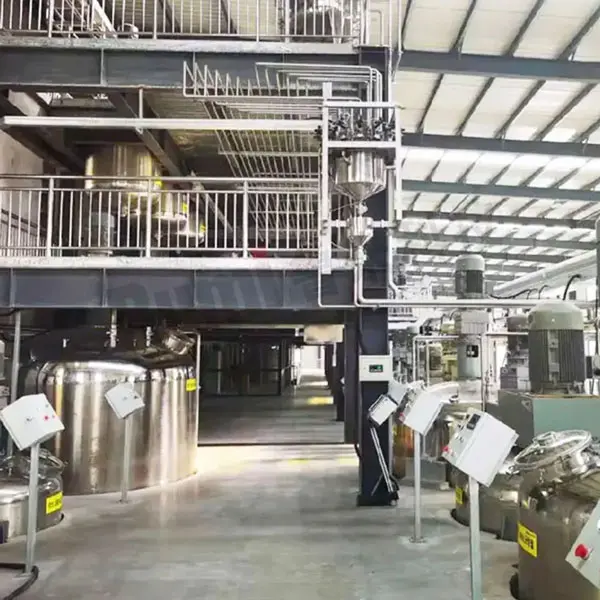
For companies comparing Industrial triple shaft mixer manufacturers, the strongest supplier is not simply the one offering the lowest quotation or the largest motor. The equipment needs to reflect how the actual material behaves throughout the entire batch.
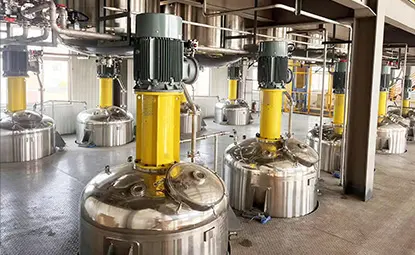
RUMI Technology approaches this from a process-engineering perspective. As a professional supplier focused on chemical equipment and solutions, RUMI has developed mixing and dosing technologies since 2018, beginning with a self-developed high-precision dosing system and high-efficiency mixing equipment. Its work has expanded into customized solutions for paint and ink manufacturers, resin and new-material companies, new energy and composite industries.
For RUMI, customization is closely connected to the formulation itself. Different blade combinations can be selected according to dispersion requirements, viscosity and process objectives, while options such as independent shaft drives, variable-frequency control, lifting dispersers, jacketed heating/cooling, SUS304 or 316L construction, vacuum operation and inert-gas protection allow the mixer to be configured around the production process.
RUMI also operates a quality assurance system that includes 72-hour factory testing and 24-hour after-sales response, with ISO9001 and CE certifications supporting its international equipment supply.
Ultimately, selecting an Industrial triple shaft mixer for sale should be treated as a process-engineering decision. The right configuration is the one that establishes sufficient shear where dispersion is needed, continuous circulation where viscosity restricts movement, and effective wall scraping where stagnant material and poor heat transfer become risks. When these three functions, together with speed control, temperature management, vacuum capability and material selection, are matched to the formulation, the mixer becomes a process tool rather than simply another piece of production equipment.
Title: Industrial Triple Shaft Mixer for High-Viscosity Processing
Keywords:
Industrial triple shaft mixer manufacturers, industrial triple shaft mixer for sale, high viscosity mixer, triple shaft mixing equipment, industrial high shear mixer
Description:
Compare triple shaft mixers for high-viscosity materials, with guidance on blade combinations, independent drives, vacuum, temperature control and material selection.