 en
en  vi
vi  it
it  es
es  tr
tr  ja
ja  pt
pt  nl
nl  ru
ru  fr
fr  de
de  pl
pl  ar
ar News
Latest news and events.




In resin manufacturing, mixing equipment directly influences product consistency, reaction efficiency, and production reliability. A resin system is often highly sensitive to temperature variation, viscosity changes, and material dispersion. When the mixing process is unstable, even small differences in agitation performance or heat transfer efficiency can lead to batch variations, extended reaction times, or inconsistent final product quality.
Many traditional mixing systems face limitations during modern chemical production. Insufficient agitation can create uneven material distribution, especially when processing high-viscosity resin systems. Poor temperature control may affect polymerization reactions, resulting in unstable viscosity and unpredictable product performance. In addition, equipment materials that are not compatible with specific chemical media may suffer from corrosion, increasing maintenance frequency and reducing service life.
For resin manufacturers, coatings companies, adhesive producers, and fine chemical enterprises, selecting suitable Resin Mixing Equipment is not simply an equipment purchase decision. It is an investment in production stability, process control, and long-term operating efficiency.
A professional resin mixing system integrates reactor design, heat transfer technology, agitation performance, condensation capability, and material selection to meet different production requirements. RUMI Technology focuses on providing chemical equipment and solutions for global customers, helping companies improve mixing efficiency and achieve more reliable fine chemical production processes.
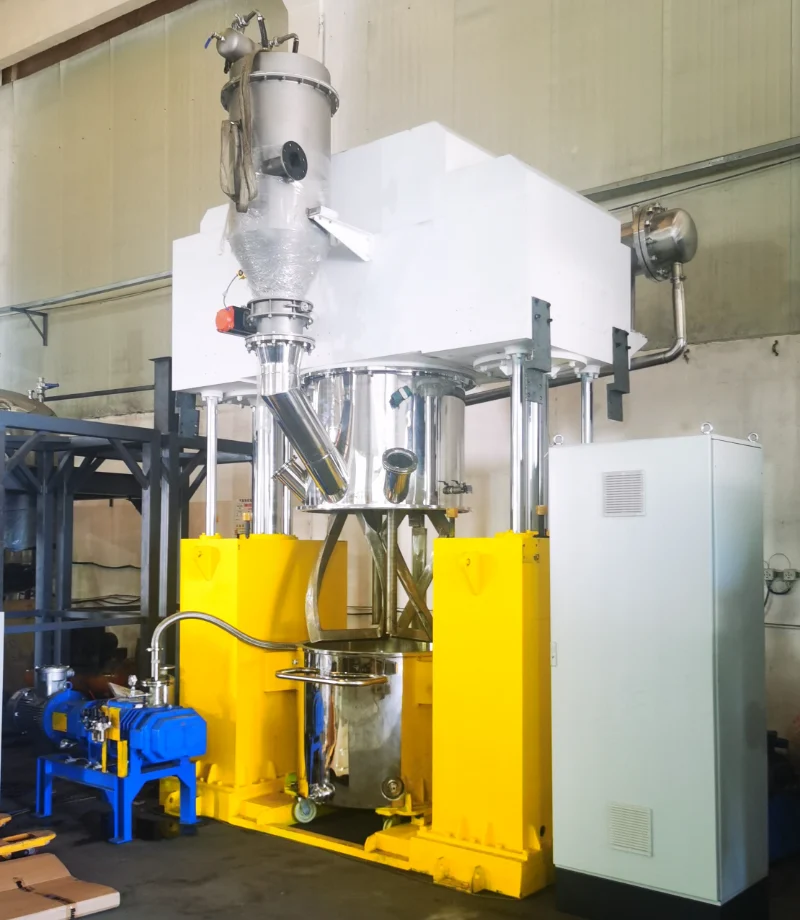
A resin reactor is the core component of resin mixing equipment. It is responsible for supporting polymerization reactions, latex production, resin modification, and other chemical processes where accurate control of temperature, mixing speed, and material movement is essential.
Unlike simple mixing tanks, professional resin reactors combine multiple functions, including:
Heat transfer management.
Agitation and material circulation.
Condensation control.
Reaction environment optimization.
The reactor structure must be designed according to the characteristics of the processed materials. Different resin systems may require different working conditions depending on viscosity, reaction temperature, corrosion resistance, and production scale.
The vessel design affects both heat distribution and mixing efficiency. Common structural options include:
Top and bottom elliptical head design.
Top flat cover with bottom elliptical head design.
Top flat cover and flat bottom structure.
These configurations allow manufacturers to select suitable reactor structures according to process requirements, installation conditions, and production capacity.
For example, elliptical head structures can provide better pressure distribution and are often suitable for demanding chemical processes, while flat-bottom structures may offer advantages in specific production layouts and cleaning requirements.
Temperature control is one of the most important factors in resin production. Polymerization and modification processes often require specific temperature ranges to achieve stable molecular structures and consistent product performance.
An efficient heat transfer system helps maintain reaction conditions by providing uniform heating and cooling throughout the vessel.
RUMI resin reactors support multiple heat transfer configurations, including:
Full jacket structures provide a large heat exchange surface around the reactor vessel.
Advantages include:
More uniform temperature distribution.
Stable heating and cooling performance.
Suitable for processes requiring precise thermal control.
This design is commonly applied in resin polymerization processes where temperature fluctuations may influence reaction results.
Dimple jacket technology improves heat exchange efficiency while maintaining structural strength.
It is suitable for applications requiring:
Faster thermal response.
Efficient energy transfer.
Reliable operation under continuous production conditions.
Coil pipe heat transfer designs provide flexible solutions for different production requirements.
They can be selected according to:
Reactor size.
Required heating or cooling speed.
Material characteristics.
For more complex production processes, combined heat transfer systems can integrate different methods to achieve better temperature control performance.
The appropriate heat transfer structure depends on factors such as resin type, reaction temperature, production cycle, and energy efficiency requirements.
The mixing system determines how effectively materials are dispersed, circulated, and reacted inside the vessel. Different resin formulations have different flow characteristics, meaning a single agitator design cannot meet every production requirement.
High-performance resin mixing equipment uses different agitation methods according to material viscosity and process objectives.
Oblique blade agitators are suitable for materials requiring efficient circulation and moderate mixing force.
Their advantages include:
Improved liquid movement.
Faster material circulation.
Effective mixing for lower and medium viscosity systems.
This type is often suitable for resin systems where rapid blending and uniform distribution are required.
Anchor agitators are commonly used for high-viscosity materials.
The structure helps:
Reduce material accumulation near the vessel wall.
Improve overall circulation.
Minimize dead zones during mixing.
For applications such as adhesives and high-viscosity resin production, anchor mixing can improve process stability by maintaining consistent material movement.
Helical ribbon agitators are designed for challenging high-viscosity applications.
They provide:
Strong axial material movement.
Improved mixing efficiency.
Better handling of dense materials.
This makes them suitable for resin systems where conventional agitation methods may not provide sufficient circulation.
Some advanced production processes require multiple mixing effects. Combined mixing systems integrate different agitation principles to achieve better dispersion, circulation, and reaction uniformity.
Selecting the correct mixing type helps manufacturers avoid common problems such as:
Uneven additive distribution.
Material buildup.
Insufficient reaction contact.
Extended processing time.
Professional resin mixing equipment is widely used across different chemical production fields. The equipment configuration can be adjusted according to the characteristics of each application.
During resin polymerization, temperature stability and mixing consistency directly affect the final molecular structure and product performance.
A properly designed reactor system helps maintain:
Stable reaction temperature.
Uniform material concentration.
Reliable batch quality.
The combination of accurate heat transfer and efficient agitation allows manufacturers to achieve more consistent production results.
Coating manufacturers require excellent dispersion and viscosity control. Uneven mixing may affect coating performance, appearance, and application properties.
Advanced mixing systems help improve:
Pigment and additive distribution.
Batch consistency.
Production efficiency.
Adhesive materials often have high viscosity and demanding mixing requirements.
Anchor and helical ribbon mixing structures can provide stronger circulation, reducing problems caused by poor flow and insufficient blending.
Latex and emulsion systems require careful control of dispersion and temperature conditions.
Stable mixing performance helps maintain:
Uniform particle distribution.
Consistent product quality.
Reliable production cycles.
When companies evaluate Resin Mixing Equipment Price, the cost difference between different systems is usually related to engineering configuration rather than only equipment size.
A lower initial price does not always represent better value. The correct equipment selection should consider production requirements, material compatibility, operating efficiency, and service life.
Equipment volume is one of the primary factors affecting price.
Larger reactors require:
More raw materials.
Stronger structural design.
Higher manufacturing complexity.
However, larger capacity equipment can improve production efficiency for companies with high-volume manufacturing needs.
The contact material significantly influences equipment cost and durability.
A commonly used stainless steel option suitable for general chemical applications.
Provides stronger corrosion resistance and is suitable for more demanding chemical environments.
A cost-effective choice for applications where corrosion resistance requirements are lower.
Used for applications requiring higher corrosion resistance and mechanical strength.
Provides additional protection for special chemical media where enhanced corrosion resistance is required.
Choosing the right material helps balance equipment investment with long-term reliability.
The agitator type, motor power, and mechanical structure influence overall equipment cost.
Different materials require different mixing solutions. Selecting the correct agitation system can improve production efficiency and reduce unnecessary energy consumption.
The condenser system is another factor affecting equipment pricing.
RUMI resin reactors support:
Horizontal tube type condensers.
Vertical condenser systems.
These designs help manage vapor condensation and support stable production processes.
Different production processes require different thermal management solutions.
Available options include:
Electrical heating rods installed in the jacket.
Mould temperature controllers.
Chiller systems.
Direct heating inside the tank.
The selection depends on:
Reaction temperature requirements.
Production efficiency targets.
Energy management considerations.
For chemical manufacturers, equipment value should be measured by production performance rather than only purchase price.
High-quality resin mixing equipment can provide long-term benefits through:
Accurate temperature control and efficient mixing reduce batch variation and improve product consistency.
Suitable materials, reliable structures, and professional manufacturing reduce equipment downtime and repair frequency.
Optimized mixing and heat transfer systems shorten processing cycles and support continuous production.
Stable reaction conditions help manufacturers achieve consistent resin performance across different production batches.
RUMI Technology has focused on chemical equipment and solutions since developing its first self-developed high-precision dosing system and high-efficiency mixing equipment in 2018. As a professional fine chemical equipment service provider, RUMI Technology has continuously improved mixing and dosing technologies through hundreds of research and development iterations, establishing its own technical advantages.
The company provides customized solutions for paint and ink enterprises, resin and new material companies, as well as new energy and composite industries. With a quality assurance system including 72-hour factory testing and 24-hour after-sales response, RUMI Technology has obtained ISO9001 and CE certifications to support global customers with reliable equipment solutions.
Choosing the right resin mixing equipment requires a comprehensive understanding of materials, reaction conditions, production goals, and long-term operational needs.
A professional system combines:
Suitable reactor structure.
Efficient heat transfer design.
Correct mixing technology.
Reliable condenser configuration.
Appropriate material selection.
For resin manufacturers and chemical processing companies, the best equipment is not simply the one with the lowest purchase cost. It is the system that provides stable production, consistent quality, lower maintenance requirements, and long-term operational value.
Through customized reactor solutions, advanced mixing technologies, and flexible heating and cooling options, RUMI Technology continues to support global fine chemical manufacturers in improving production efficiency and building more reliable chemical processing systems.