 en
en  vi
vi  it
it  es
es  tr
tr  ja
ja  pt
pt  nl
nl  ru
ru  fr
fr  de
de  pl
pl  ar
ar News
Latest news and events.



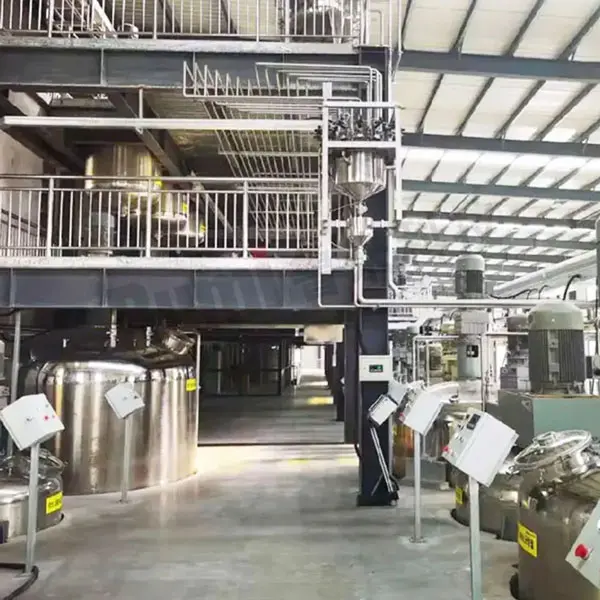
A chemical mixing tank is not simply a vessel for holding liquids. In actual production, an improperly configured tank can leave material unmixed near the bottom or wall, allow powders and solids to settle, create excessive vortexing, or produce local differences in concentration and temperature. The problem becomes more pronounced when a plant handles materials ranging from low-viscosity cleaning solutions to high-viscosity resins, adhesives, coatings, and slurries.
For this reason, selecting a Chemical Mixing Tank with Agitator should start with the process duty rather than tank capacity alone. Viscosity, density, solid content, working volume, mixing objective, required temperature, chemical compatibility, and operating conditions all determine the appropriate tank and agitation system.
The main components of an industrial chemical mixing tank include the tank body, agitator, impeller, shaft, motor, gearbox, baffles, mechanical seal, jacket, and temperature control system. Each component affects the way material moves through the vessel.
The impeller determines the primary flow pattern. Axial-flow impellers move material mainly parallel to the shaft, creating strong top-to-bottom or bottom-to-top circulation. They are commonly considered when bulk circulation, blending, dissolution, or keeping suspended solids in motion is important.
Radial-flow turbine impellers generate a stronger flow perpendicular to the shaft and can provide higher local shear. They may be appropriate when dispersion or gas-liquid interaction requires more intense fluid movement. However, higher shear is not automatically better. Excessive shear can be undesirable for some emulsions, polymers, biological materials, or products where particle structure needs to be preserved.
Propellers generally suit relatively low-viscosity liquids where rapid circulation is more important than high torque. Paddles provide broader, slower movement and can be useful for moderate-viscosity materials. Anchor agitators operate close to the tank wall and are particularly relevant to high-viscosity resins, adhesives, and other materials where wall heat transfer and bulk movement are difficult to maintain.
The agitator cannot be selected independently of the tank geometry. Impeller diameter, RPM, shaft configuration, liquid level, tank diameter-to-height ratio, and baffle arrangement work together to determine circulation patterns.
Baffles are particularly important in tanks handling low- to medium-viscosity liquids. Without sufficient baffle action, the liquid may rotate around the vessel with the shaft instead of circulating effectively through the tank. This creates a vortex and reduces useful vertical circulation. Properly positioned baffles interrupt rotational flow and help redirect energy into axial circulation, improving movement between the upper and lower sections of the tank.
Motor power is also only one part of the selection. A high-viscosity resin may require substantially more torque at relatively low speed, while a low-viscosity liquid may require higher RPM with comparatively lower torque. Therefore, the required mixing speed and motor power should be established from viscosity, density, impeller geometry, batch volume, and the required mixing result rather than by copying the motor size of another tank.
For solid-liquid mixing, the objective may be to prevent sedimentation rather than simply homogenize two liquids. In this case, impeller position, diameter, bottom clearance, axial circulation, and solid loading become critical. A system designed for liquid blending may not provide enough bottom circulation to suspend a high concentration of particles.
Chemical compatibility is another major part of equipment design. Selecting 304 or 316/316L stainless steel simply because it is described as corrosion resistant is not sufficient. The actual chemical concentration, pH, operating temperature, exposure time, and cleaning media should be considered together.
For example, 316L may be selected for applications where greater chemical resistance is required than a standard stainless-steel construction can provide. For highly corrosive environments, polymer-lined or non-metallic construction such as PP, PVDF, or FRP may be more appropriate. The compatibility assessment should cover not only the tank shell but also the shaft, impeller, mechanical seal, gasket, fittings, and internal components.
Temperature control is similarly connected to the process. A jacketed chemical mixing tank can provide a controlled surface for heating or cooling the product. This is useful when viscosity changes significantly with temperature, when a resin must remain within a specific processing range, or when a chemical reaction requires controlled heat removal.
The heating or cooling requirement also affects jacket design, heat-transfer area, circulation conditions, insulation, and temperature instrumentation. A tank that mixes correctly at ambient temperature may behave differently when the product becomes significantly more viscous during cooling.
Other configurations depend on the process. A mechanical seal is important when leakage must be controlled around the rotating shaft. Vacuum operation may be required for deaeration, solvent removal, or certain material-processing steps, while pressure-rated construction is necessary for processes that operate above atmospheric pressure. Inert-gas protection can be considered when oxidation, moisture exposure, or flammable atmospheres are process concerns.
These configurations answer several common purchasing questions:
How does a chemical mixing tank work?
The agitator transfers mechanical energy into the material through the impeller, while tank geometry and baffles direct that energy into the circulation pattern required by the process.
How do I choose an agitator for a chemical mixing tank?
Start with viscosity, density, solids content, working volume, mixing objective, desired shear level, and required mixing time. The agitator and impeller should then be selected around these conditions.
What material is best for a chemical mixing tank?
There is no universal material. Stainless steel, PP, PVDF, FRP, or other constructions should be evaluated against the actual chemical, concentration, temperature, exposure duration, and cleaning procedure.
Can a chemical mixing tank heat and cool products?
Yes. A properly designed jacket and temperature control system can support controlled heating and cooling, provided the heat-transfer requirements are matched to the product and process.
For coating and ink production, dispersion and controlled shear may be important. Resin and adhesive production can place greater demands on torque and wall circulation. Cleaning chemicals may require careful material compatibility, while water-treatment chemicals can involve dilution, blending, or solid suspension. These differences explain why one agitator configuration cannot cover every chemical application.
When comparing a Chemical Mixing Tank for Sale, buyers often begin with nominal tank volume and price per liter. This can be misleading because two tanks with the same nominal capacity may have very different process capabilities.
A useful comparison should include:
What size chemical mixing tank do I need? The answer depends on batch size, working volume, required headspace, foaming behavior, solids loading, and process expansion plans. A tank should not normally be selected by filling its nominal capacity to 100% because the required operating level may be lower.
How much does a chemical mixing tank cost? The price depends on the complete configuration rather than capacity alone. A simple atmospheric stainless-steel tank with a basic agitator has a different cost structure from a jacketed, vacuum-rated tank with variable-speed control, specialized seals, corrosion-resistant materials, and automated temperature management.
This is why buyers should evaluate total process value rather than simply comparing the initial vessel price. Mixing time, batch consistency, energy consumption, maintenance requirements, component replacement, and future production capacity can all affect the long-term economics of the equipment.
RUMI Technology is a professional supplier focused on chemical equipment and solutions, serving global customers with reliable products, strict quality control, and efficient service while building long-term partnerships worldwide.
Since launching its first self-developed high-precision dosing system and high-efficiency mixing equipment in 2018, RUMI Technology has focused on its role as a professional fine chemical equipment service provider. Through hundreds of R&D iterations, the team has developed its own technical capabilities and obtained multiple invention patents.
Its equipment solutions are developed around different process requirements, including improved dosing accuracy for paint and ink manufacturers, mixing equipment for resin and new-material production, and system solutions for new energy and composite-material applications. RUMI Technology also operates a quality assurance system that includes 72-hour factory testing and 24-hour after-sales response, with ISO9001 and CE certifications.
For an overseas buyer, the practical question is therefore not simply which Chemical Mixing Tank with Agitator has the largest motor or lowest quoted price. The more relevant question is whether Tank Capacity + Working Volume + Agitator Type + Impeller Design + Viscosity + Mixing Speed + Motor Power + Baffle Design + Material Compatibility + Temperature Control match the actual process duty.
A properly specified chemical mixing system should produce the required circulation, suspension, blending, dissolution, shear, and heat transfer without forcing the equipment to operate outside its intended conditions. That process-based approach is also the most reliable way to evaluate a Chemical Mixing Tank for Sale and determine which configuration provides the required production performance and long-term operating economics.