 en
en  vi
vi  it
it  es
es  tr
tr  ja
ja  pt
pt  nl
nl  ru
ru  fr
fr  de
de  pl
pl  ar
ar News
Latest news and events.




In paint, ink, resin, adhesive, pigment, putty, and other chemical production processes, mixing performance is often limited by more than agitator speed. A conventional single-shaft mixer may disperse material effectively in one local area while leaving insufficient circulation elsewhere. Powder can form agglomerates after entering the liquid phase, high-viscosity material may move slowly near the vessel wall, and product can remain attached to the tank surface. During heating or cooling, poor circulation can also create temperature differences between the vessel wall and the bulk material.
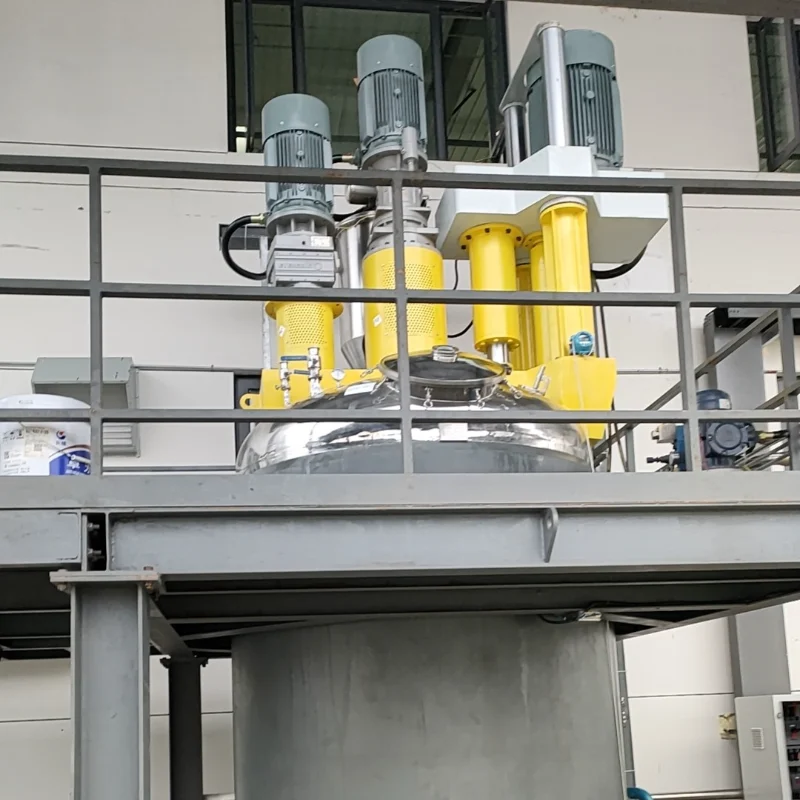
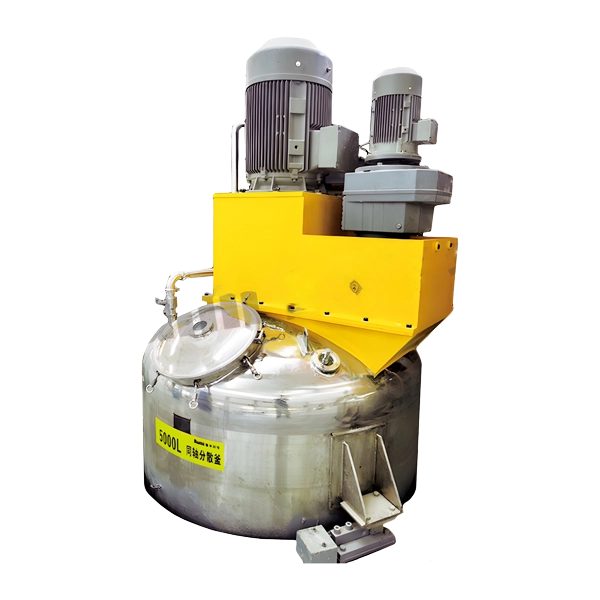
An industrial dispersing mixer with two independently driven agitators approaches these problems differently. A high-speed dispersing disc creates an intense shear zone for powder wetting and particle deagglomeration, while a low-speed anchor agitator continuously moves the bulk material toward the dispersing area. A PTFE wall scraper also removes material from the vessel wall, reducing stagnant zones and improving heat transfer. For medium- and high-viscosity formulations, this combination can have a direct influence on dispersion quality, processing time, and batch consistency.
The main feature of a double-shaft industrial dispersing mixer is the concentric shaft arrangement. One shaft drives the high-speed disperser, while the other operates the low-speed anchor agitator. Because the two agitators have independent drives, their speeds can be adjusted according to the formulation and processing stage.
The high-speed dispersing disc is responsible for localized high-shear dispersion. When powder is introduced into a liquid or semi-liquid base, the disc generates strong turbulence and shear around its working zone. This helps break down agglomerates and distribute solid particles through the liquid phase instead of allowing larger powder clusters to remain intact.
The anchor agitator performs a different function. Its larger sweeping diameter moves the bulk material around the vessel and directs material toward the high-speed dispersing disc. This continuous circulation is particularly important when viscosity increases and natural material movement becomes weaker.
The PTFE scraper mounted on the anchor structure further improves circulation. It removes material from the internal vessel wall so that less product remains in a relatively stagnant layer. This is useful not only for mixing uniformity but also for heat transfer when the tank is equipped with a heating or cooling jacket.
The result is not simply “two agitators mixing at the same time.” The process depends on the interaction between high-speed shear and low-speed bulk circulation. The disperser breaks down and distributes particles, while the anchor brings fresh material back into the dispersing zone.
A high-speed disperser alone can provide strong localized shear, but its circulation capability becomes increasingly important as viscosity and batch volume rise. A double-shaft system adds a low-speed anchor to move the entire batch through the high-shear region.
For high-viscosity formulations, this distinction matters. Increasing disperser speed does not automatically solve poor bulk circulation. Excessive speed can increase energy consumption and introduce unnecessary air into some formulations, while areas farther from the dispersing disc may still move slowly.
Independent speed control allows the operator to establish a more suitable balance between shear intensity and material circulation.
The mixer configuration should be selected according to viscosity, solids content, batch volume, temperature requirements, and process conditions rather than treated as a fixed package.
Hydraulic lifting raises and lowers the mixing head during loading, processing, and unloading. Stable vertical movement is particularly useful for larger industrial vessels where manual handling is impractical.
Frequency converter control allows the high-speed disperser and anchor agitator to operate at adjustable speeds. Different stages may require different conditions—for example, stronger shear during powder dispersion and controlled circulation during final homogenization.
A jacketed tank provides a controlled path for heating or cooling media. However, jacket installation alone does not guarantee uniform temperature. The anchor agitator and wall scraper are important because they keep material near the vessel wall moving and help transfer heat into the bulk material.
For oxygen-sensitive, solvent-based, or oxidation-sensitive formulations, an airtight vessel with vacuum capability or inert gas protection can provide additional process control. Vacuum operation can also be relevant when air removal is part of the formulation process.
For wetted components, SS304 stainless steel is a common configuration, while SS316L can be specified when greater corrosion resistance or particular material compatibility is required.
Digital speed display can provide direct operating feedback, while PLC/HMI control can be integrated when the production line requires more structured parameter management and automation.
The required mixer configuration changes with the formulation.
In paint and coating production, pigment wetting and deagglomeration are major concerns. The dispersing disc provides the shear needed to distribute pigment particles, while the anchor maintains circulation through the batch.
For ink production, particle dispersion, viscosity, and temperature can affect final product consistency. The mixer must provide sufficient shear without treating speed as the only process variable.
For resins and adhesives, viscosity can increase substantially during formulation or reaction. A large-diameter anchor with PTFE scraping becomes increasingly relevant because bulk movement and wall clearance become more difficult as viscosity rises.
In putty and gel production, the material may resist flow strongly enough that a conventional paddle leaves areas of limited circulation. The combination of anchor movement, wall scraping, and high-speed dispersion can provide a more controlled material path.
This is why questions such as Can an industrial dispersing mixer handle high-viscosity materials? cannot be answered from motor power alone. The actual selection should consider viscosity range, solids loading, batch volume, required processing time, agitator geometry, shaft configuration, and temperature conditions.
There is no meaningful single price for an industrial dispersing mixer because the equipment configuration can change substantially from one production requirement to another.
Working volume is one of the first factors. A larger effective batch capacity generally requires a larger vessel, stronger shafts, larger agitators, and higher drive power.
Disperser and anchor power also affect the configuration. A formulation with high solids content or high viscosity may require substantially different drive sizing from a low-viscosity liquid.
The dispersing disc diameter and operating speed determine the shear conditions and dispersing capability. Meanwhile, the anchor agitator must provide sufficient torque for bulk circulation.
Other major price factors include:
Hydraulic lifting capacity and structure
Frequency converter or VFD configuration
Jacketed heating/cooling system
Vacuum-rated vessel and sealing system
Inert gas protection
SS304 or SS316L wetted parts
Mechanical seal configuration
PLC/HMI automation
Explosion-proof motor and electrical components where required
Therefore, when buyers ask How much does an industrial dispersing mixer cost?, comparing two quotations based only on the headline price can be misleading. A lower initial quotation may represent a smaller batch capacity, lower drive specification, simpler sealing, limited temperature control, or fewer automation functions.
The more useful comparison is the total production value: batch size, processing time, energy consumption, cleaning requirements, maintenance, temperature control, and expected operating conditions should all be considered alongside the purchase price.
The capability of the manufacturer matters because a double-shaft mixer is a process system rather than simply a tank with two motors.
A capable manufacturer should be able to evaluate material viscosity, solids content, batch volume, processing sequence, temperature requirements, and vacuum conditions before recommending the agitator and drive configuration.
Buyers should also examine whether the manufacturer can integrate the major systems: high-speed disperser, anchor agitator, hydraulic lifting, VFD speed control, jacketed vessel, vacuum system, inert gas protection, and PLC/HMI controls.
Manufacturing details deserve equal attention. Vessel welding, shaft alignment, sealing, scraper clearance, pressure/vacuum design, wetted-material selection, and factory testing can directly affect long-term operation.
For customized equipment, sample testing or factory trials can be particularly useful. Instead of relying solely on catalog specifications, manufacturers can evaluate whether the proposed dispersing disc, anchor geometry, speed range, and power configuration are appropriate for the actual formulation.
RUMI Technology approaches industrial mixing from this process-oriented perspective. Since developing its first self-developed high-precision dosing system and high-efficiency mixing equipment in 2018, RUMI has focused on fine chemical equipment solutions for applications including paints, inks, resins, new materials, composites, and other chemical processes. Its equipment development has involved hundreds of R&D iterations and invention patents, while its quality system includes 72-hour factory testing and 24-hour after-sales response. The company operates with ISO9001 and CE certifications and provides customized equipment and system solutions for global customers.
The correct size should start with the actual working batch, not simply the total tank volume. Buyers should define the minimum and maximum batch sizes, material viscosity, powder loading, target processing time, required temperature range, and whether vacuum or inert gas operation is necessary.
The question What size dispersing mixer do I need? therefore requires more than selecting a vessel by volume. A mixer that is oversized for a small batch may operate inefficiently, while an undersized dispersing system may require excessive processing time or fail to provide adequate circulation.
For high-viscosity production, the key is to match anchor torque, disperser shear, working volume, scraper configuration, and thermal control with the formulation.
An industrial dispersing mixer is most effective when its mechanical structure matches the behavior of the material being processed. The high-speed dispersing disc provides localized shear for powder wetting and particle deagglomeration; the low-speed anchor continuously circulates the bulk material; and the PTFE scraper reduces wall buildup and supports more consistent heat transfer.
For overseas buyers, Industrial Dispersing Mixer Price should therefore be evaluated together with capacity, drive configuration, viscosity handling, temperature control, sealing, automation, and long-term operating requirements. At the same time, choosing among Industrial Dispersing Mixer Manufacturers requires examining engineering capability, customization, manufacturing quality, testing procedures, and after-sales support—not simply comparing quotation totals.