en
 vi
 it
 es
 tr
 ja
 pt
 nl
 ru
 fr
 de
 pl
 ar
News
Latest news and events.




Automotive paint production requires more than simply combining liquid ingredients. Pigments and other solid materials must be properly wetted, dispersed, and distributed throughout the liquid phase to achieve consistent coating properties. When conventional mixing equipment cannot provide sufficient shear or effective material circulation, manufacturers may encounter pigment agglomeration, uneven color distribution, poor dispersion, and excessive air entrainment. These issues can affect downstream processing and make batch-to-batch consistency more difficult to maintain.
For automotive paint manufacturers and industrial coating factories, selecting suitable Automotive Paint Mixing Equipment is therefore an important production decision. High-speed dispersers offer a practical solution for processing liquid coatings and slurries by combining high-speed blade rotation with controlled material circulation. However, equipment selection should also account for formulation viscosity, solid content, batch capacity, temperature requirements, and operating conditions.
Understanding how a high-speed disperser works, what configurations are available, and which factors influence Paint Mixing Equipment Price can help manufacturers select equipment that matches their actual production requirements.
A high-speed disperser uses a toothed disc blade, typically featuring an up-and-down saw-tooth profile, to generate strong liquid movement inside a mixing vessel.
When the disc rotates at high speed, it creates radial flow that pushes the surrounding material outward toward the vessel walls. This movement continuously draws fresh material into the high-shear region around the blade. The resulting shear forces help break down pigment agglomerates, improve powder wetting, and distribute solid particles throughout the liquid.
It is important to distinguish dispersion from ordinary mixing. Conventional agitation primarily promotes circulation and blending between components. High-speed dispersion applies greater local shear to help separate particle clusters and improve their distribution. Dissolution, meanwhile, involves a solid material entering the liquid phase at a molecular or ionic level. Not every pigment or powder dissolves during processing; many remain as dispersed solid particles in the finished coating.
For automotive paint production, this distinction matters because pigment distribution directly influences the consistency of the coating formulation. A suitable dispersion process helps reduce visible agglomerates and localized pigment concentration differences, although the final result also depends on pigment characteristics, formulation chemistry, and processing conditions.
Choosing Automotive Paint Mixing Equipment requires evaluating several technical parameters together rather than focusing only on motor speed.
Motor power and dispersing disc diameter: Motor power determines the equipment's ability to drive the disc under the resistance created by the material. Disc diameter influences the working area and peripheral speed. Both should be matched to the vessel dimensions, batch volume, and material viscosity.
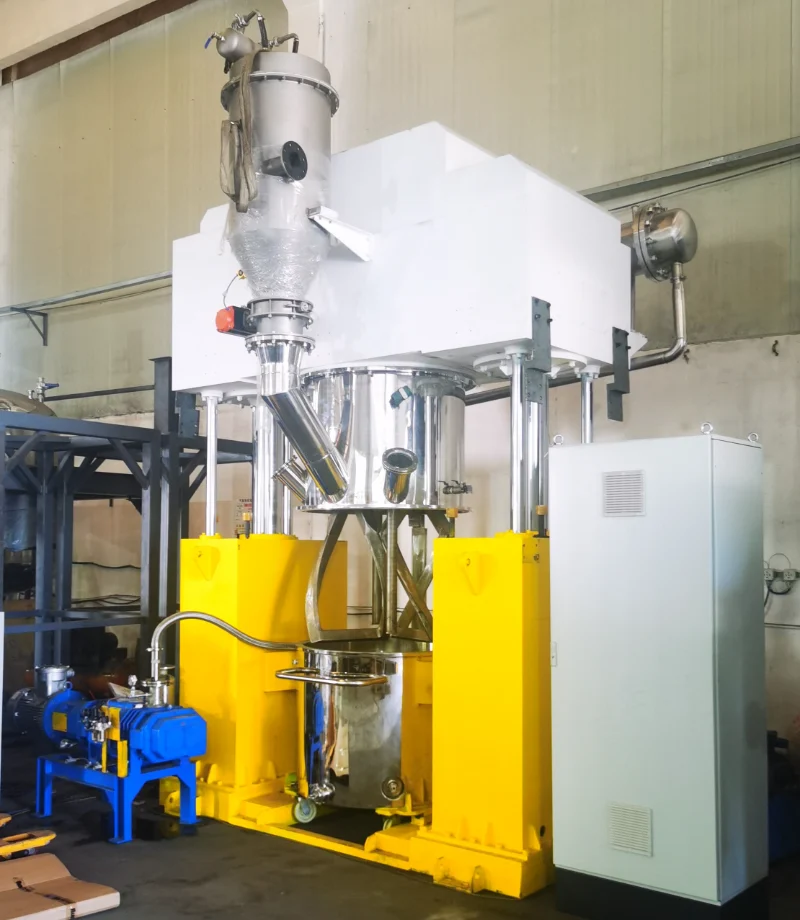
Rotational speed and linear velocity: RUMI's high-speed disperser can reach a maximum rotational speed of 1440 rpm, with a linear velocity of approximately 20 m/s. These specifications support rapid material circulation and high-shear dispersion around the disc.
However, maximum speed does not automatically produce the same dispersion result for every formulation. Different pigments, solid contents, and viscosity levels require different operating conditions. Excessive speed may also increase air entrainment or temperature rise, depending on the formulation and vessel configuration.
Processing capacity and viscosity: The vessel capacity and motor configuration should correspond to the intended batch size. A machine designed for a small laboratory batch may not provide the same processing conditions in a large industrial vessel. Manufacturers should also consider the material's viscosity during different production stages, rather than evaluating only its initial viscosity.
Industrial coating manufacturers often require additional configurations to accommodate formulation and operating conditions.
Variable frequency control: A frequency converter provides stepless speed adjustment, allowing operators to change disc speed according to material viscosity, powder addition stages, and dispersion requirements.
Jacketed mixing tank: A jacket can circulate water or thermal oil for heating or cooling. This helps manage process temperature when material properties are sensitive to temperature changes.
Vacuum and inert gas protection: An airtight structure can be configured for vacuum operation or inert gas protection. Vacuum processing helps remove entrained air and reduce bubbles in the finished material, while inert gas protection may be appropriate for formulations requiring a controlled atmosphere.
Stainless steel contact parts: Stainless Steel 304 is the standard wetted material, while SS316L is available as an optional configuration for applications requiring different material compatibility.
Explosion-proof configuration: This option can be considered for production environments involving flammable solvents or other relevant hazards. The required electrical and mechanical protection must be determined through a proper hazard assessment.
Installation options: Floor-mounted equipment is suitable for installations where the machine can stand independently. Platform-installed designs can be incorporated into production layouts where equipment positioning and available floor space require a different arrangement.
RUMI can customize equipment configurations according to customer requirements rather than assuming that every production line needs the same combination of features.
High-speed dispersers are commonly used during powder incorporation, pigment wetting, premixing, and dispersion processing.
In automotive primer production, for example, pigments and functional powders need to be distributed throughout the liquid formulation. The dispersing disc helps bring powder particles into contact with the liquid and applies shear to reduce agglomeration.
For automotive topcoats, maintaining consistent pigment distribution is important for formulation uniformity and subsequent coating operations. The disperser supports this process, although final coating appearance also depends on pigment selection, resin compatibility, particle size, and downstream processing.
Industrial paints, water-based coatings, latex paints, inks, adhesives, and dyes can also benefit from high-speed dispersion. The specific operating conditions must be selected according to each formulation.
RUMI's high-speed disperser is designed for middle-to-large-batch processing of liquid materials and slurries with viscosity below 20,000 cps and solid content below 60%. These figures describe the stated application range of this equipment configuration, not a universal processing standard for all high-speed dispersers or automotive paint formulations.
Material viscosity influences how easily the liquid circulates around the dispersing disc. Lower-viscosity materials generally allow easier circulation, while higher-viscosity formulations create greater resistance to movement.
As viscosity increases, operators may need to adjust rotational speed, batch loading, and processing conditions to maintain effective material circulation. Motor power and disc dimensions should also be evaluated against the actual material characteristics.
Solid content is another important consideration. Increasing the powder proportion changes the resistance of the slurry and the amount of material that needs to be wetted and dispersed. If powder is introduced too quickly, localized accumulation and agglomeration may occur.
A controlled powder-feeding process, combined with appropriate disc speed and sufficient processing capacity, helps improve dispersion consistency.
Temperature control is particularly relevant when processing formulations whose viscosity or chemical behavior changes with temperature.
A jacketed tank allows heating or cooling media, such as thermal oil or water, to circulate through the jacket. This provides a way to manage process temperature during mixing and dispersion. The appropriate heating or cooling medium depends on the formulation and required operating temperature.
Air entrainment is another concern. High-speed blade rotation can introduce air into certain liquid formulations, particularly when the blade position, immersion depth, or operating speed is unsuitable.
An airtight vessel with vacuum capability can help remove entrained air during processing. This is useful when bubble reduction is an important requirement for the finished coating. Vacuum operation should be matched to the material's foaming characteristics and the vessel's design pressure.
By combining suitable dispersion speed, temperature management, and optional vacuum processing, manufacturers can establish more controlled production conditions across different formulations and batches.
For manufacturers comparing Paint Mixing Equipment Price, the initial quotation is only one part of the purchasing decision. Two machines may have similar appearances but differ considerably in motor capacity, vessel construction, processing capabilities, and optional systems.
The following factors commonly influence equipment pricing.
Processing capacity and motor power: Larger batch requirements generally involve different vessel dimensions and drive configurations. Higher motor power may be necessary when processing more demanding materials, affecting the overall equipment cost.
Dispersing disc specifications: Disc diameter, construction, and configuration influence the machine's working conditions and manufacturing requirements.
Tank material: Stainless Steel 304 is the standard wetted material in RUMI's stated configuration. Choosing optional SS316L may increase material and manufacturing costs, depending on the equipment design.
Heating and cooling systems: A jacketed tank introduces additional vessel construction and connection requirements. The final cost depends on the jacket design and associated process requirements.
Vacuum and inert gas systems: Airtight construction, vacuum connections, and associated equipment increase configuration complexity. These options should be selected when the production process requires them.
Explosion-proof requirements: Explosion-proof motors and other relevant electrical components can affect equipment pricing. The specification should correspond to the actual production environment and applicable safety requirements.
Installation and automation: Floor-mounted and platform-installed arrangements may involve different structural and installation requirements. Additional automation, instrumentation, and customized control systems can also influence the quotation.
A lower initial quotation does not necessarily represent a lower long-term production cost.
For example, if a disperser cannot provide sufficient circulation for a particular batch size, operators may need to adjust the production process or use additional processing equipment. This can affect production scheduling and operating expenses.
Similarly, choosing unsuitable contact materials or inadequate sealing arrangements may increase maintenance requirements in the long run.
Before comparing quotations, buyers should evaluate:
Whether the motor and dispersing disc match the actual formulation and batch capacity.
Whether the speed-control system provides the required operating flexibility.
Whether heating, cooling, vacuum, or inert gas protection is genuinely necessary.
Whether the wetted materials are compatible with the chemicals being processed.
Whether the machine has undergone factory testing before delivery.
Whether the manufacturer can provide technical support, spare parts, and after-sales service.
Requesting a configuration-based quotation is more useful than comparing equipment prices without understanding what each machine includes.
RUMI Technology focuses on fine chemical equipment and customized process solutions for global industrial customers.
Since developing its first self-developed high-precision dosing system and high-efficiency mixing equipment in 2018, the company has continued investing in equipment research and development. Its technical development includes multiple iterations and invention patents, supporting customized solutions for paint and ink manufacturers, resin producers, new materials companies, and other industrial sectors.
For coating manufacturers, RUMI's approach focuses on matching equipment configurations to actual production requirements, including dispersion performance, dosing accuracy, material compatibility, and process conditions.
Its quality assurance system includes 72-hour factory testing and a 24-hour after-sales response commitment. The company also holds ISO9001 and CE certifications.
When evaluating a supplier, buyers should discuss their formulations, viscosity ranges, solid content, batch sizes, and required production conditions before confirming the final configuration. This allows the manufacturer to assess motor power, disc dimensions, vessel capacity, and optional systems based on practical operating requirements.
Selecting suitable Automotive Paint Mixing Equipment involves more than choosing a machine with a high rotational speed. Pigment wetting, particle dispersion, material circulation, temperature management, and air control all influence the production process.
RUMI's high-speed disperser offers a maximum speed of 1440 rpm and an approximate linear velocity of 20 m/s, with optional configurations such as variable frequency control, jacketed tanks, vacuum processing, and SS316L wetted parts.
For manufacturers comparing Paint Mixing Equipment Price, the most practical approach is to define the actual formulation, batch capacity, viscosity, solid content, temperature requirements, and safety conditions first. A properly configured machine can provide a better balance between processing requirements, equipment investment, and long-term production needs.