 en
en  vi
vi  it
it  es
es  tr
tr  ja
ja  pt
pt  nl
nl  ru
ru  fr
fr  de
de  pl
pl  ar
ar News
Latest news and events.



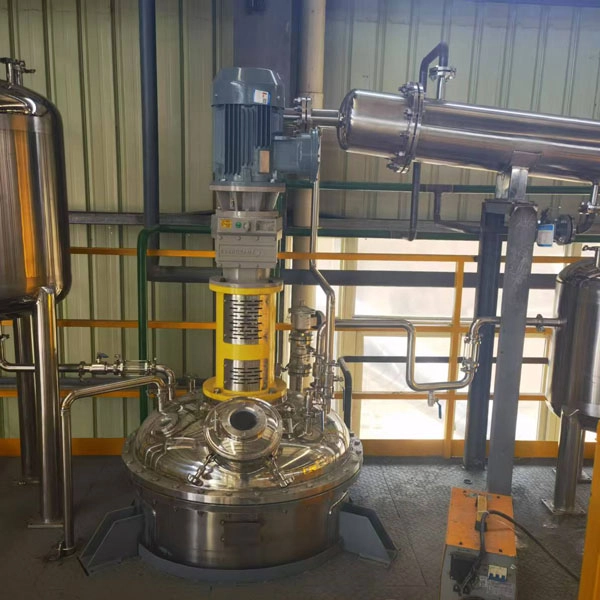
In high-end chemical manufacturing and advanced material processing industries, Industrial planetary blending equipment is designed as a multi-field mechanical processing system rather than a conventional agitation device. Its primary engineering objective is to achieve simultaneous macro-scale circulation and micro-scale dispersion within extremely high-viscosity, multi-phase materials where conventional mixers fail to maintain uniform shear distribution.
Rumi Technology, a professional supplier specializing in chemical equipment and precision mixing systems, has developed its planetary mixing technology through continuous R&D since 2018. The company integrates dosing accuracy systems, high-efficiency mixing platforms, and intelligent control architectures into a unified engineering solution, supported by ISO9001 and CE certification standards. The focus is on delivering stable, repeatable, and high-torque mixing performance for industries such as energy materials, advanced polymers, adhesives, and fine chemicals.
The fundamental advantage of Industrial planetary blending equipment manufacturers lies in its dual-motion architecture, where mixing elements rotate on their own axis while simultaneously revolving around the central axis of the mixing vessel. This motion generates a continuously evolving shear field that eliminates stagnant zones and ensures complete material circulation even in ultra-high viscosity systems.
The orbital motion system continuously transports materials between low-shear and high-shear zones inside the tank, ensuring that all particles experience uniform mechanical processing throughout the mixing cycle, which is critical for preventing localized agglomeration and ensuring consistent dispersion quality in high-solid-content formulations
The dual-speed interaction between planetary paddles and high-speed dispersers generates multi-layer shear gradients that enable both bulk homogenization and micro-scale particle breakdown, significantly improving dispersion efficiency in complex multi-phase chemical systems such as lithium slurries and structural adhesives
The PTFE wall scraper system continuously removes material from the inner tank surface and reintroduces it into the active mixing zone, preventing thermal degradation, material buildup, and dead-zone formation during long-duration high-viscosity mixing cycles
High-viscosity materials require not only rotational motion but stable torque output under continuously changing resistance conditions. In planetary mixing systems, torque stability directly determines whether uniform dispersion can be maintained when viscosity increases due to chemical reactions, temperature shifts, or solid loading variations.
The high-torque servo drive system ensures that mechanical output remains stable even under extreme resistance loads, preventing speed fluctuation that would otherwise lead to incomplete dispersion or material separation. This is essential for industrial applications where batch consistency directly affects product performance.
The closed-loop torque feedback system continuously monitors resistance changes in real time and dynamically adjusts motor output, ensuring that mixing stability is maintained even under sudden viscosity transitions during reactive chemical processing stages
The frequency converter control architecture coordinates torque and rotational speed in real time, preventing overload conditions while maintaining optimal shear conditions required for uniform dispersion in high-viscosity formulations
The reinforced transmission system ensures long-term mechanical stability under continuous load conditions, reducing fatigue wear and maintaining consistent torque delivery across extended production cycles
Vacuum integration in planetary mixing systems plays a critical role in ensuring structural integrity and material uniformity, particularly in high-performance chemical formulations where trapped gases can significantly impact final product quality.
Vacuum conditions eliminate entrapped air during the mixing process, preventing bubble formation and internal voids that could compromise mechanical, electrical, or structural performance. This is especially important in battery slurries, electronic adhesives, and precision polymer systems.
Thermal control through jacketed tank systems further enhances process stability by maintaining materials within optimal viscosity ranges throughout the entire mixing cycle, ensuring consistent shear behavior and dispersion efficiency.
Vacuum degassing eliminates micro-bubbles and entrapped air pockets during high-viscosity mixing, significantly improving material density uniformity and reducing structural defects in final products used in energy storage and adhesive applications
Heating and cooling jacket systems allow precise thermal regulation, ensuring that material viscosity remains within controlled process windows, which stabilizes shear response and improves batch-to-batch consistency in industrial production environments
Airtight mixing environments prevent oxidation and unwanted chemical reactions, preserving material integrity during sensitive formulation processes involving reactive or multi-component chemical systems
Industrial planetary blending systems are widely used in sectors where material uniformity directly determines final product performance and reliability. These include energy materials, polymer systems, and high-performance adhesives.
In lithium battery slurry production, consistent dispersion directly impacts electrode efficiency and electrochemical performance. In structural adhesives, uniform particle distribution determines bonding strength and long-term durability. In resin systems, batch consistency ensures predictable mechanical and thermal properties across large-scale production.
Lithium battery slurry production requires stable dispersion of conductive materials and binders to ensure consistent electrochemical performance and prevent electrode performance variation caused by particle aggregation or uneven distribution
Structural adhesive manufacturing relies on uniform shear processing to maintain bonding strength consistency, ensuring that mechanical performance remains stable across different production batches and application environments
Advanced resin and composite systems depend on controlled rheology and dispersion uniformity to maintain mechanical strength, thermal stability, and structural integrity during large-scale industrial production processes
Rumi Technology applies a strict engineering validation system that includes 72-hour continuous factory testing for all planetary mixing equipment prior to delivery. This ensures that torque stability, vacuum performance, and mixing uniformity meet industrial-grade production requirements.
The company continuously optimizes mixing geometry, transmission architecture, and flow field dynamics to enhance dispersion efficiency and reduce energy consumption under high-viscosity conditions. This iterative engineering approach has resulted in multiple patented technologies that form the core of its industrial mixing solutions.
Long-term industrial production requires equipment that maintains mechanical precision and process stability under continuous operational stress. Planetary mixing systems must therefore ensure consistent performance across extended duty cycles without degradation in torque output or mixing uniformity.
Bearing and transmission systems are engineered for high-load fatigue resistance, ensuring stable mechanical performance during continuous 24/7 operation in demanding chemical production environments where downtime is costly and process stability is critical
Sealing systems and vacuum interfaces are designed for long-term airtight stability, preventing performance degradation caused by leakage or pressure imbalance during extended production cycles
Structural reinforcement design ensures that vibration, load stress, and thermal expansion do not compromise alignment accuracy or mixing geometry consistency over long operational periods
Industrial planetary blending equipment for sale represents a core process technology in high-viscosity material manufacturing, where performance is defined not by mixing ability alone but by long-term stability, torque consistency, and dispersion uniformity under complex conditions.
Rumi Technology integrates planetary motion engineering, high-torque drive systems, and vacuum thermal control into a unified mixing architecture designed for demanding industrial environments. This ensures that users achieve not only efficient mixing performance but also long-term process reliability, batch consistency, and scalable production stability in advanced chemical and energy material industries.