 en
en  vi
vi  it
it  es
es  tr
tr  ja
ja  pt
pt  nl
nl  ru
ru  fr
fr  de
de  pl
pl  ar
ar News
Latest news and events.



In industrial coating production, achieving consistent dispersion is often more difficult than simply combining liquid ingredients. Paint formulations usually contain pigments, fillers, resins, additives, and solvents with different flow characteristics. When conventional mixing equipment is used for high solid content or medium-to-high viscosity materials, problems such as pigment agglomeration, uneven color distribution, unstable viscosity, and inconsistent batch quality can occur.
These challenges become more noticeable in products such as latex paint, industrial coatings, water-based inks, adhesives, and dye solutions. Each formulation requires a different balance between shear force, mixing speed, and temperature control. A mixing system that works for low-viscosity liquids may not provide enough dispersion force for pigment-rich coatings.
An industrial paint mixer is designed to address these production requirements by combining high-speed dispersion technology, stable material circulation, and adjustable operating parameters. The right equipment selection can directly influence coating quality, production consistency, and long-term manufacturing costs.
The core function of an industrial paint mixer is not only mixing but also efficient dispersion. During coating production, pigments and solid particles must be evenly distributed throughout the liquid phase to achieve stable color, viscosity, and performance.
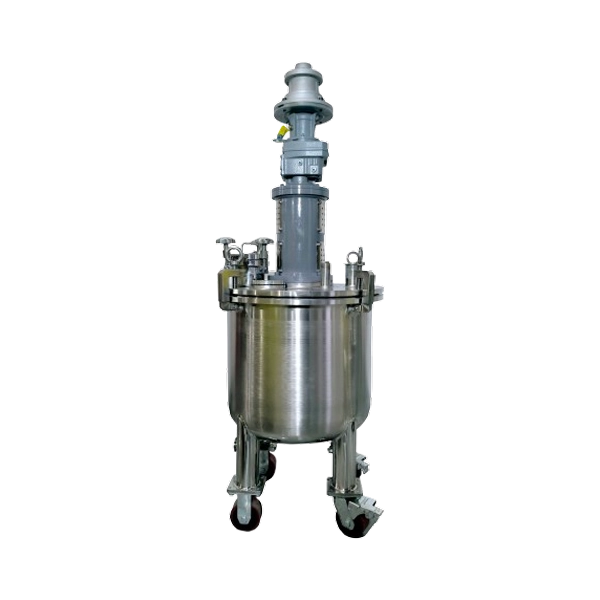
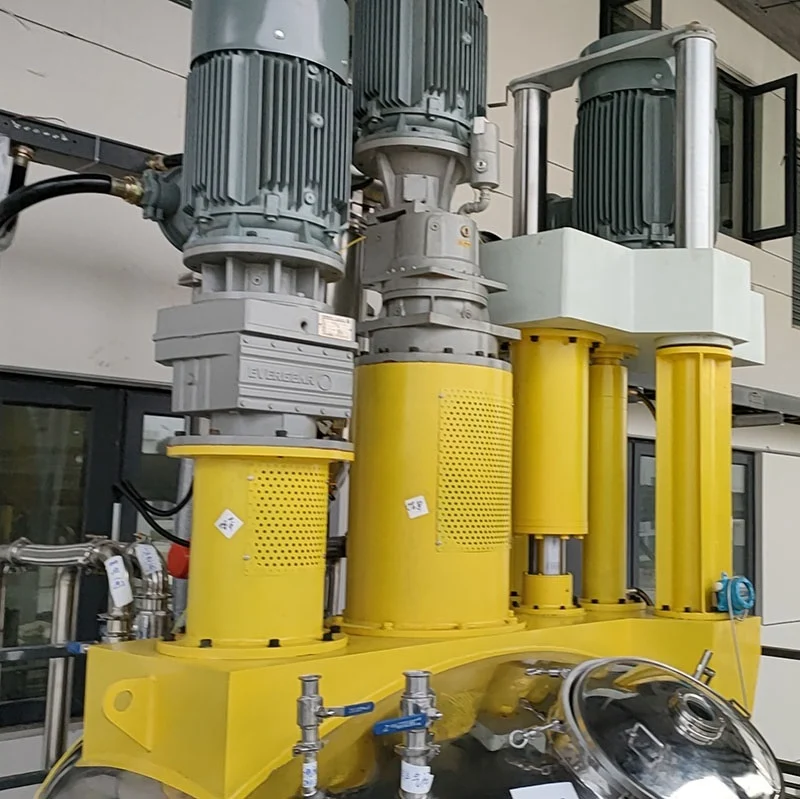
The high-speed disperser used in industrial paint mixing equipment adopts an up-and-down saw-tooth disc blade design. When the blade rotates at high speed, it creates strong radial flow inside the mixing vessel. The generated circulation pushes materials toward the edge of the blade, where intense shear forces break down agglomerated particles and accelerate wetting and dissolution.
This process improves:
Pigment dispersion quality
Particle distribution consistency
Color stability between batches
Mixing efficiency of liquid-solid systems
Compared with standard agitators that mainly provide simple circulation, a high shear disperser creates a stronger mechanical force field. This makes it more suitable for industrial coatings and slurry materials where particle breakdown and uniform distribution are critical.
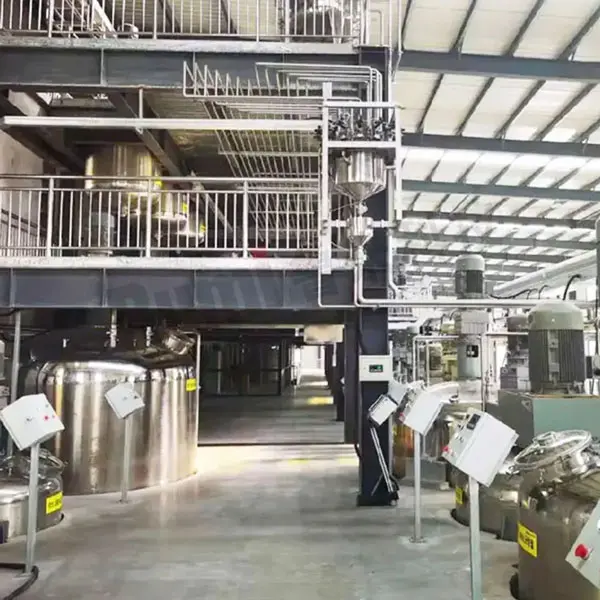
The motor is mounted on the top of the tank, allowing stable transmission of power directly to the dispersing shaft. Depending on production layout requirements, the equipment can be designed as a floor-mounted system or a platform-installed type.
Different coating formulations require different mixing speeds. A fixed-speed mixer may not provide sufficient flexibility when manufacturers handle materials with changing viscosity or solid content.
Industrial paint mixers equipped with frequency converter control allow stepless speed adjustment. Operators can modify the rotational speed according to:
Material viscosity
Solid content percentage
Dispersion requirements
Production stage
For example, a high-solid industrial coating may require stronger shear force during the initial dispersion stage, while a finished paint formulation may need controlled mixing to maintain product structure.
The ability to precisely adjust speed helps manufacturers avoid excessive shear that could affect sensitive materials while ensuring enough force for difficult-to-disperse components.
RUMI Technology develops chemical equipment and customized mixing solutions for global industrial customers. Since launching its first self-developed high-precision dosing system and high-efficiency mixing equipment in 2018, RUMI has focused on becoming a professional fine chemical equipment service provider.
Through continuous research and development iterations, the RUMI Technology team has developed advanced mixing and dosing technologies for industries including paint, ink, resin, new materials, and energy-related applications. The company provides customized equipment solutions supported by strict quality management, including 72-hour factory testing and 24-hour after-sales response. With ISO9001 and CE certifications, RUMI continues to deliver reliable equipment solutions for customers worldwide.
Industrial paint mixer performance depends not only on the dispersing blade but also on the overall equipment configuration. Different production environments may require additional functions to maintain stable processing conditions.
Temperature changes can significantly affect coating viscosity and material flow behavior. A jacketed mixing tank allows oil or water to pass through the jacket for heating or cooling.
This configuration helps maintain stable processing temperatures for materials that require thermal control, improving:
Mixing consistency
Material flow stability
Product repeatability
Some coating and chemical formulations are sensitive to air exposure or require reduced bubble formation. An airtight industrial paint mixer can operate under vacuum conditions or be protected with inert gas.
These functions help:
Reduce trapped air in finished products
Minimize oxidation risks
Improve final coating performance
This is especially valuable for applications where surface quality and long-term product stability are important.
Certain paint manufacturing environments involve flammable solvents or volatile materials. Explosion-proof industrial paint mixers are designed to meet safety requirements in these conditions.
This configuration may include explosion-proof motors and electrical components suitable for specific industrial environments, helping manufacturers maintain safer production processes.
When searching for an industrial paint mixer price, buyers often find significant differences between equipment quotations. These variations are usually related to machine configuration, manufacturing requirements, and application conditions.
Several factors influence the final investment:
Larger production batches require larger vessels and stronger drive systems. Equipment designed for medium to large-scale production usually requires higher motor power and more robust mechanical structures.
A mixer designed for laboratory testing and a machine designed for continuous industrial coating production naturally have different cost levels.
The material of wetted parts directly affects durability and application compatibility.
Stainless Steel 304 is commonly selected for general industrial coating applications due to its corrosion resistance and cost balance.
SS316L provides higher corrosion resistance and is often selected for more demanding chemical environments.
The choice between SS304 and SS316L affects initial equipment cost but also influences service life and maintenance requirements.
Additional systems can change the equipment investment, including:
Vacuum operation
Inert gas protection
Heating and cooling jackets
Explosion-proof design
Customized installation structure
Automation control systems
Instead of focusing only on initial purchase price, manufacturers should evaluate how equipment configuration affects production stability and operating costs over the machine lifecycle.
Selecting suitable industrial paint mixer manufacturers requires evaluating more than manufacturing capacity. A professional supplier should understand both equipment engineering and coating production processes.
Important factors include:
Experienced manufacturers should be able to analyze:
Material viscosity
Solid content
Batch size
Dispersion requirements
Production environment
Based on these factors, they can recommend suitable mixing structures and configurations.
Different factories may require different installation methods and process solutions. A reliable manufacturer should provide options such as:
Floor-mounted industrial paint mixers
Platform-installed mixers
Explosion-proof configurations
Vacuum sealing systems
Temperature-controlled tanks
Customization ensures the equipment matches the actual production workflow instead of forcing production processes to adapt to standard equipment.
Professional manufacturers should have strict production processes, equipment testing procedures, and application experience across multiple industries.
RUMI Technology focuses on customized solutions for paint and ink companies, resin manufacturers, and new material enterprises. By combining engineering development with manufacturing experience, RUMI helps customers achieve stable mixing performance for different industrial formulations.
Industrial paint mixers are widely used for medium to large batch production of liquid materials and slurries with viscosity below 20,000 cps and solid content below 60%.
Typical applications include:
Latex Paint
Requires stable dispersion of pigments and additives to maintain color consistency and coating performance.
Industrial Paint
Demands strong shear capability to process higher solid content formulations and achieve uniform particle distribution.
Water-Based Ink and Printing Ink
Requires precise dispersion control to maintain color accuracy and printing quality.
Adhesives
Often contain high-viscosity components that require strong circulation and stable mixing force.
Dyes
Need effective dissolution and uniform concentration distribution.
For these applications, a properly configured industrial paint mixer helps reduce production variation, improve dispersion quality, and minimize material waste caused by inconsistent batches.
Choosing an industrial paint mixer requires a complete evaluation of dispersion capability, equipment configuration, material compatibility, and manufacturer expertise. High-speed saw-tooth dispersion technology, precise speed control, temperature management, and customized safety features allow modern mixing equipment to handle demanding coating and slurry production requirements.
When comparing industrial paint mixer options, companies should consider long-term production value rather than only the initial equipment price. A reliable manufacturer with strong engineering experience can provide a mixing solution that improves product consistency, reduces production risks, and supports stable manufacturing operations.