 en
en  vi
vi  it
it  es
es  tr
tr  ja
ja  pt
pt  nl
nl  ru
ru  fr
fr  de
de  pl
pl  ar
ar News
Latest news and events.



High viscosity materials create some of the most demanding challenges in industrial mixing. When conventional agitators are used for products such as printing inks, sealants, adhesives, magnetic slurries, or cosmetic pastes, poor material circulation often becomes a major limitation. The mixture may move slowly, creating dead zones inside the vessel, while insufficient shear force can leave pigment clusters, fillers, or other solid components unevenly dispersed.
These problems directly affect production quality. Inconsistent mixing can lead to unstable viscosity, uneven color performance, reduced product strength, and batch-to-batch variations. The difficulty increases further because different materials require completely different mixing conditions. A low-shear blending process suitable for one formulation may not work for a high-solid-content adhesive or a highly viscous paste.
For this reason, selecting the right triple shaft mixer machine requires more than considering motor power or tank capacity. Manufacturers need equipment that can combine strong dispersion, effective circulation, and continuous wall scraping to handle complex industrial formulations.
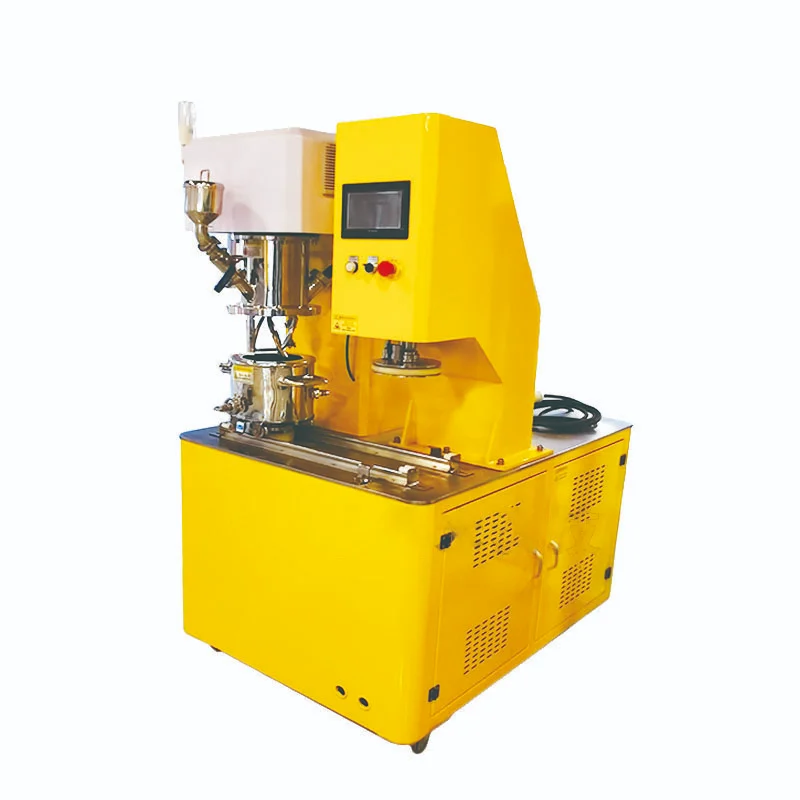
A triple shaft mixing machine is specifically designed for medium to high viscosity materials by integrating three independently driven mixing systems into one unit. Unlike traditional single-shaft mixers that rely on one movement pattern, the triple shaft structure allows different mixing actions to work together according to the characteristics of the material.
The typical configuration includes:
High-speed dispersing disc
Helical blade
Anchor blade with wall scraper
Each component performs a specific role during the mixing process.
The high-speed disperser generates strong shear force to break down agglomerates and improve particle distribution. This function is especially important for materials containing pigments, fillers, or solid additives, such as printing inks and magnetic slurry.
The helical blade creates vertical and horizontal circulation inside the vessel. Since high viscosity materials naturally resist movement, the helical structure helps transfer material between different areas of the tank, reducing uneven concentration zones.
The anchor blade with wall scraper focuses on areas where traditional mixers often struggle. By continuously moving along the vessel wall, it reduces material buildup and improves heat transfer during temperature-controlled mixing.
The combination of these three systems allows the machine to achieve a balance between dispersion, blending, and material circulation.
Different industrial formulations require different mixing strategies. A professional triple shaft mixer machine is not limited to one fixed blade arrangement but can be configured according to viscosity, particle size, shear requirements, and production objectives.
Common configurations include:
High-speed dispersing disc + helical blade + anchor blade with scraper
This configuration provides balanced performance for general high viscosity mixing applications. The dispersing disc improves particle breakdown, while the helical blade and anchor scraper maintain overall material movement.
Two high-speed dispersers + anchor blade with scraper
This design increases dispersion capability for formulations requiring stronger shear forces, such as high-pigment inks or composite materials.
High-speed disperser + rotor/stator + anchor blade with scraper
The rotor/stator system provides intensive homogenization, making it suitable for applications where finer particle distribution and improved product texture are required.
By selecting the correct blade combination, manufacturers can optimize mixing performance without applying excessive mechanical force that may damage sensitive formulations.
Beyond the mixing structure itself, equipment configuration plays a critical role in long-term production performance.
A major advantage of a triple shaft system is the use of three independently driven agitators. Each shaft can operate at different speeds, allowing operators to adjust dispersion intensity, circulation speed, and scraping action according to the material condition.
For example, a highly viscous adhesive may require strong circulation at a lower speed combined with intensive local dispersion, while a cosmetic cream may require controlled shear to maintain product texture.
The high-speed disperser can also be designed with lifting and rotating movement. This structure improves contact between the dispersing element and the material, allowing better processing of different filling levels and viscosity conditions.
Additional functions further expand application flexibility:
Frequency converter speed control
Variable speed adjustment allows precise control of shear force and mixing intensity. This helps manufacturers optimize recipes instead of relying on fixed operating conditions.
Jacketed tank heating and cooling
Temperature control is essential for many high viscosity materials. A jacketed vessel connected with a heater or chiller helps maintain the required processing temperature, preventing viscosity changes that could affect mixing results.
Vacuum mixing and inert gas protection
An airtight design allows the machine to operate under vacuum conditions to reduce air bubbles in products such as sealants and adhesives. Inert gas protection can also help protect oxidation-sensitive materials during processing.
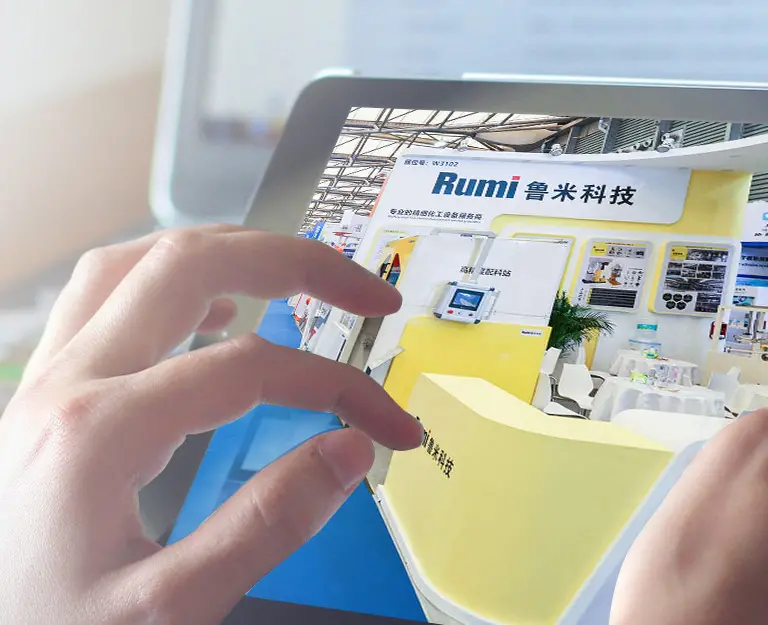
RUMI Technology develops chemical equipment solutions for global industrial customers with a focus on high-performance mixing and dosing systems. Since launching its first self-developed high-precision dosing system and high-efficiency mixing equipment in 2018, RUMI has continued developing as a professional fine chemical equipment service provider.
Through hundreds of research and development iterations, the RUMI Technology team has created advanced mixing technologies and customized solutions for industries including coatings, inks, resin materials, new energy, and composite materials. The company combines engineering development with strict manufacturing standards, supported by a quality assurance system featuring 72-hour factory testing and 24-hour after-sales response. RUMI products have achieved ISO9001 and CE certifications, providing international customers with reliable equipment solutions.
Selecting suitable triple shaft mixing machine manufacturers is an important decision because mixing performance depends heavily on equipment design and application experience.
A reliable manufacturer should understand the relationship between material properties and machine configuration. Important evaluation factors include:
Mixing technology development capability
Experienced manufacturers should be able to analyze viscosity, solid content, particle characteristics, and process requirements before recommending a machine design.
Customization capability
Industrial customers often require different tank volumes, blade combinations, automation levels, or vacuum systems. A capable manufacturer should provide customized solutions rather than only standard models.
Material selection expertise
The choice of contact material affects equipment durability and application compatibility.
SUS304 is commonly selected for general industrial applications due to its corrosion resistance and cost efficiency.
SUS316L provides stronger corrosion resistance and is preferred for more demanding environments, including chemical, food, and pharmaceutical applications where higher material requirements are necessary.
Manufacturing and testing capability
Reliable suppliers should have strict production controls, equipment testing procedures, and experience supporting international customers.
RUMI Technology focuses on customized solutions for different industries, helping paint and ink companies improve dispersion consistency, supporting resin and new material manufacturers with efficient mixing systems, and providing integrated solutions for new energy and composite applications.
The performance requirements of high viscosity materials vary widely across industries.
Printing ink production
Ink manufacturers require excellent pigment dispersion and stable viscosity control. High-speed dispersing systems help reduce pigment agglomeration and improve color consistency.
Sealants and adhesives
These materials often contain high filler content and require strong circulation. Vacuum mixing capability helps minimize air bubbles and improve final product quality.
Hot melt adhesives
Temperature management is critical because viscosity changes significantly with heat variation. Jacketed tanks provide stable thermal control during processing.
Magnetic media slurry
Uniform distribution of magnetic particles is essential for product performance. Strong dispersion and controlled circulation help maintain consistent material properties.
Creams, lotions, and toothpastes
These products require smooth texture, uniform composition, and controlled shear conditions. Proper blade selection helps achieve stable and repeatable results.
Across these applications, the value of a triple shaft mixer is not simply faster mixing. Its real advantage lies in maintaining consistent product quality when processing materials that are difficult to move, disperse, and control.
Choosing the right triple shaft mixing machine requires careful evaluation of mixing structure, material compatibility, configuration flexibility, and manufacturer expertise. For high viscosity applications, the combination of independently driven agitators, advanced blade designs, precise speed control, and controlled processing environments provides a reliable solution for complex formulations.
When selecting equipment, companies should look beyond the initial machine price and consider long-term production value, including mixing consistency, maintenance requirements, material adaptability, and technical support from the manufacturer. Working with an experienced triple shaft mixing equipment supplier helps ensure stable operation and a mixing solution that matches future production needs.