 en
en  vi
vi  it
it  es
es  tr
tr  ja
ja  pt
pt  nl
nl  ru
ru  fr
fr  de
de  pl
pl  ar
ar News
Latest news and events.



Choosing an industrial storage tank is rarely just a matter of selecting a volume and material. In actual production, the tank has to work with the stored medium, operating temperature, viscosity, corrosion conditions, cleaning method and production cycle. A material that performs well with one chemical may be unsuitable for another, while a basic storage vessel may become inefficient when the process requires heating, cooling or continuous mixing.
This is why industrial storage tank selection should begin with the process rather than the tank itself. The right structure can improve temperature control, material compatibility and operating efficiency, while the wrong configuration can lead to corrosion, difficult cleaning, uneven temperature distribution or unnecessary maintenance.
Industrial storage tanks are available in many configurations because storage requirements vary significantly between industries. Capacity is important, but tank geometry, construction material and auxiliary systems often have a greater effect on performance.
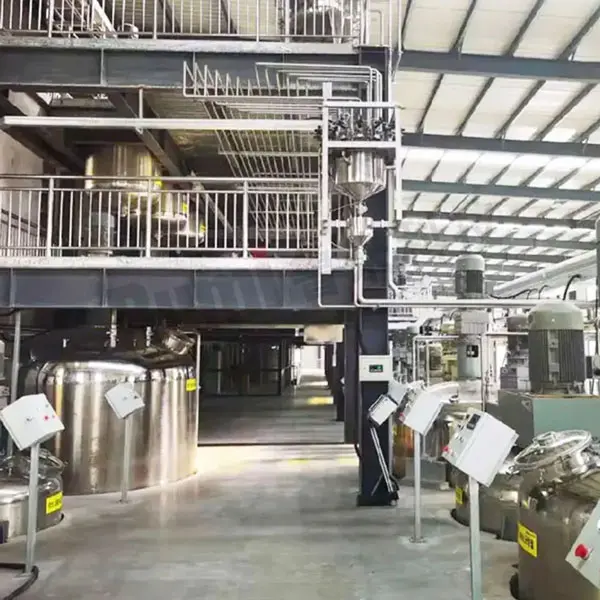
Powder carbon steel storage tanks are a practical choice when the stored material is compatible with carbon steel and the process does not require the higher corrosion resistance of stainless steel. Carbon steel offers good mechanical strength and can be economical for larger-volume applications. It is commonly considered for industrial raw materials, powders and other relatively non-corrosive materials where structural strength and storage capacity are priorities.
The material compatibility must still be checked carefully. Moisture, acidic compounds, alkaline substances and other corrosive media can significantly change the suitability of carbon steel. Surface treatment or internal lining may also be considered depending on the process.
Stainless steel horizontal storage tanks are useful where corrosion resistance, cleanliness and relatively low installation height are important. The horizontal configuration can be practical when available headroom is limited or when the process layout favors horizontal material transfer. Stainless steel is particularly relevant to food processing, pharmaceutical production and chemical applications where material compatibility and cleanability are important.
For higher hygiene requirements, the stainless-steel grade, surface finish, weld quality and internal geometry should be evaluated together rather than treating "stainless steel" as a complete specification.
Outer half pipe coil tanks use an external half-pipe coil to transfer heat between the tank wall and the process medium. This arrangement can provide controlled heating or cooling while keeping the heat-transfer structure outside the vessel interior. It can be useful for viscous materials or processes where maintaining a controlled temperature is necessary without introducing an internal heating element.
Inner coil tanks place the heat-transfer coil inside the tank. This can provide direct heat exchange with the stored medium and may be suitable for certain heating or cooling processes. However, the coil occupies internal space and can affect cleaning, material flow and mixing. For products that require frequent cleaning or have a tendency to deposit on surfaces, these factors need to be considered during design.
Honeycomb jacketed tanks provide another approach to temperature management. The jacketed structure creates a heat-transfer area around the vessel, allowing a heating or cooling medium to circulate outside the product-contact zone. This configuration is particularly useful when the process requires stable temperature control and a clean internal tank surface.
Movable tanks are designed for production environments where materials need to be transferred between processing areas. They can reduce intermediate handling steps and support batch-based production. Their value is not simply mobility; the tank frame, lifting or transportation method, connection design, capacity and center of gravity all need to match the facility's operating method.
Double-layer vertical mixing tanks combine storage with agitation. They are suitable when the material cannot remain homogeneous during storage or when mixing is part of the production process. The double-layer structure can also accommodate temperature-control functions, while the vertical geometry provides a practical arrangement for an agitator and larger working volumes.
The important point is that these are not interchangeable tank designs. A storage tank for a low-viscosity liquid has very different requirements from a vessel handling a viscous resin, temperature-sensitive formulation or continuously mixed chemical compound.
Material selection starts with the stored medium. Chemical composition, concentration, temperature, residence time and cleaning conditions can all influence corrosion behavior.
Carbon steel can be appropriate for compatible non-corrosive materials and applications where structural strength and cost efficiency are important. Stainless steel becomes more attractive when corrosion resistance, hygiene and cleanability are key considerations. For chemical applications, however, the exact stainless-steel grade should be selected according to the medium and operating conditions rather than assuming every stainless-steel tank has the same chemical resistance.
Tank structure is equally important.
A jacket is generally considered when the process requires indirect heating or cooling. It can be useful for maintaining a target temperature, compensating for heat loss or controlling the viscosity of temperature-sensitive materials.
A coil may be preferable when a specific heat-transfer arrangement is required. The decision between an outer half-pipe coil and an inner coil depends on factors such as heat-transfer requirements, available surface area, cleaning requirements and whether the internal coil could interfere with material movement.
A mixing system becomes necessary when storage alone is insufficient. Suspensions may settle, viscous materials may develop temperature or concentration gradients, and multi-component formulations may require continuous homogenization. Agitator selection should therefore consider viscosity, density, solids content, batch volume and required mixing intensity.
For chemical manufacturers, corrosion resistance and process compatibility usually dominate the selection process. Food and pharmaceutical manufacturers place greater emphasis on hygienic construction, cleanable surfaces and material-contact requirements. In resin, coatings and new-material production, viscosity and temperature control may make jacketed or mixed tanks more appropriate than conventional storage vessels.
Choosing among industrial storage tank manufacturers should involve more than comparing quoted prices. A capable manufacturer should be able to translate process conditions into a practical vessel configuration.
How do I choose an industrial storage tank manufacturer?
Start with manufacturing capability. Ask whether the supplier routinely builds tanks with the required materials, dimensions, capacities and auxiliary systems. Welding quality, dimensional control, surface treatment and factory testing should also be part of the evaluation.
What types of industrial storage tanks are available?
The manufacturer should be able to provide different configurations rather than forcing every application into a standard vessel. Depending on the process, this may include carbon steel tanks, stainless steel horizontal tanks, half-pipe coil tanks, internal-coil tanks, honeycomb jacketed tanks, movable tanks and vertical mixing tanks.
Should I choose carbon steel or stainless steel?
The answer depends primarily on the stored medium and operating conditions. Carbon steel can make sense for compatible materials where strength and cost are important. Stainless steel is generally considered when corrosion resistance, hygiene or cleanability has a greater influence on the process. The specific material grade should be verified against the actual medium, concentration and temperature.
When is a jacketed tank necessary?
A jacketed configuration is worth considering when the product needs controlled heating or cooling during storage or processing. It is particularly relevant to materials whose viscosity, stability or flow characteristics change with temperature.
Can industrial storage tanks be customized for specific materials and processes?
Yes, provided the manufacturer has genuine engineering and fabrication capability. A meaningful customization process should consider the material, working and total capacity, tank dimensions, operating temperature, pressure requirements, corrosion conditions, heating or cooling method, agitator requirements, connections, discharge configuration and installation environment.
Rumi Technology approaches tank customization from this process-oriented perspective. Since developing its first high-precision dosing system and high-efficiency mixing equipment in 2018, RUMI Technology has focused on fine chemical equipment and customized process solutions. Its product range includes powder carbon steel storage tanks, stainless steel horizontal storage tanks, outer half-pipe coil tanks, inner coil tanks, honeycomb jacketed tanks, movable tanks and double-layer vertical mixing tanks.
For buyers, this range is useful because the tank can be selected around the actual process instead of treating storage capacity as the only design variable. RUMI Technology has developed customized equipment for paint and ink, resin and new materials, as well as new-energy and composite-material applications. Its quality system includes 72-hour factory testing and 24-hour after-sales response, with ISO9001 and CE certifications.
A manufacturer cannot properly engineer a custom industrial storage tank from capacity alone. At minimum, the procurement specification should identify:
Stored material and chemical characteristics
Working and total volume
Required tank dimensions and orientation
Material and corrosion conditions
Operating and design temperature
Operating and design pressure
Heating or cooling requirements
Jacket or coil configuration
Agitation requirements and material viscosity
Inlet, outlet and drain arrangements
Cleaning requirements
Fixed or movable installation
Site limitations and connection requirements
These details allow the manufacturer to determine whether a simple storage vessel, temperature-controlled tank or integrated mixing system is more appropriate.
For industrial buyers, the strongest sign of engineering capability is not the number of tank models listed in a catalog. It is the supplier's ability to connect material properties and process conditions with tank geometry, construction material, heat-transfer design, mixing configuration and manufacturing tolerances.
An industrial storage tank should ultimately be treated as part of the production system. When material compatibility, structure, temperature control, mixing and fabrication quality are evaluated together, buyers can select a vessel that fits the actual process rather than simply purchasing a container with the required volume.