 en
en  vi
vi  it
it  es
es  tr
tr  ja
ja  pt
pt  nl
nl  ru
ru  fr
fr  de
de  pl
pl  ar
ar News
Latest news and events.



Conventional mixers can become inefficient when the material is thick enough to resist circulation. High-viscosity compounds may move slowly, leave material against the vessel wall, form poorly mixed zones, or require extended processing time. High-speed mixing alone may also introduce excessive air into products such as silicone, sealants, structural adhesives, and battery slurries. For manufacturers working with these materials, the right planetary mixer is not simply a machine with a larger motor. The mixing geometry, dispersion system, wall scraping, vacuum capability, temperature control, and batch capacity all determine whether the equipment can deliver a repeatable process.
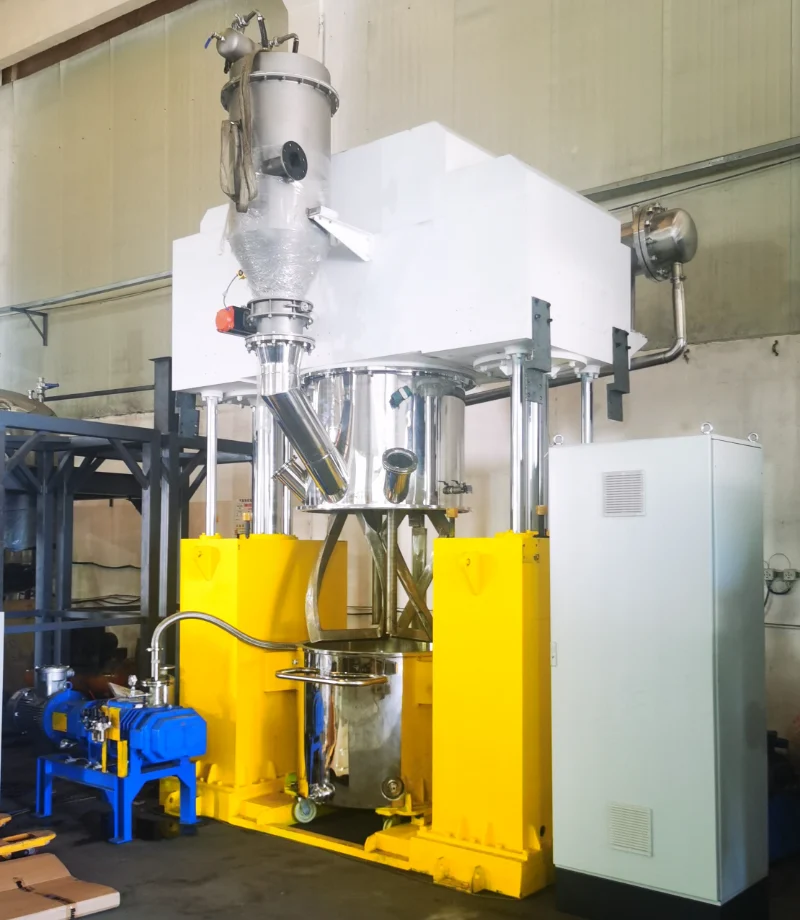
A heavy duty planetary mixer addresses these challenges by combining planetary movement with individual agitator rotation. Rumi’s vacuum double planetary mixer adds double planetary paddles, a high-speed disperser, and PTFE wall scrapers to handle demanding high-viscosity formulations. This configuration is designed for applications ranging from putty and silicone gel to lithium battery slurry, solder paste, ceramic paste, sealants, structural adhesives, soft cream, and toothpaste.
The main advantage of a planetary mixer is that the mixing elements do not remain in one fixed circular path. The double planetary paddles rotate on their own shafts while simultaneously revolving around the center of the vessel. This combined movement continuously changes the contact position between the agitators and the material.
For high-viscosity compounds, this is important because material cannot rely on natural circulation in the same way that low-viscosity liquids do. The planetary paddles repeatedly move through different sections of the batch, helping transfer material from one region to another. The result is more effective bulk mixing without depending solely on high rotational speed.
The high-speed disperser performs a different function. While the planetary paddles provide overall material turnover, the dispersing disc introduces localized high-shear action. This is useful when powders, pigments, fillers, or other components must be broken down and distributed through a viscous base. The combination is therefore more versatile than using a single slow-speed agitator for every stage of the process.
The PTFE wall scraper completes the system by continuously sweeping material from the vessel wall. Without effective scraping, viscous compounds can remain on the tank surface and become difficult to reincorporate. Wall scraping also helps reduce dead zones and product accumulation, which can be particularly important when processing expensive materials or formulations with strict composition requirements.
This combination explains why planetary mixing is well suited to materials such as silicone gel, sealants, structural adhesives, ceramic paste, solder paste, and lithium battery slurry. These materials can have high resistance to flow and may contain powders or functional additives that require both bulk mixing and dispersion.
For a manufacturer evaluating the best heavy duty planetary mixer, the important question is therefore not simply how fast the agitator rotates. It is whether the complete mixing system provides the right balance between bulk turnover, dispersion intensity, wall coverage, and processing time.
Vacuum capability becomes particularly valuable when the formulation is sensitive to air inclusion or oxidation. During mixing, air can become entrained in viscous materials and may be difficult to release because the material does not flow easily. A vacuum environment helps remove this trapped gas during processing and reduces contact between the material and atmospheric oxygen.
For applications such as adhesives, sealants, silicone compounds, and battery-related materials, minimizing bubbles can improve the consistency of the finished product and reduce defects associated with entrained air. Vacuum mixing is not automatically necessary for every formulation, however. The requirement should be determined by the material’s sensitivity to air, the acceptable bubble level, and the downstream application.
Rumi’s vacuum double planetary mixer can also operate under inert-gas protection when the process requires controlled atmospheric conditions. This gives manufacturers another option when oxygen exposure needs to be minimized but the process is not intended to run under vacuum throughout the entire cycle.
Temperature control is equally important for high-viscosity processing. A jacketed tank can be connected to heating or cooling equipment so that the material temperature can be adjusted according to the formulation and process requirements. Heating may reduce viscosity and improve material movement during certain stages, while cooling can control temperature rise caused by mixing or protect temperature-sensitive ingredients.
The practical value is better process control rather than simply adding a heating function to the machine. For a formulation whose viscosity changes significantly with temperature, controlling the tank temperature can directly affect mixing torque, dispersion behavior, processing time, and final consistency.
Automation also influences production efficiency. A PLC touch screen allows operators to manage machine functions through a centralized interface, while frequency-converter control provides adjustable mixing speed. Different materials may require different combinations of planetary and disperser speeds, so variable-speed control gives the operator greater flexibility than a fixed-speed system.
The hydraulic lifting system raises and lowers the tank or mixing head into the required working position. Safety limit switches prevent the mixer from operating when the vessel or agitators are not correctly positioned. In production environments, these functions are relevant not only to convenience but also to repeatability and operational safety.
Rumi offers planetary mixer capacities from 30L to 2000L, giving manufacturers room to select equipment according to batch size rather than forcing every application into the same machine format. Capacity should not be selected solely according to the nominal volume of a formulation. The actual working volume, material expansion, required mixing space, viscosity, powder loading, and batch cycle should all be considered.
A 30L-class mixer may be appropriate for laboratory-scale production, development work, or smaller specialty batches, while larger 2000L equipment can support substantially higher production requirements. The correct selection depends on the required batch output and how many cycles the production line must complete per shift.
Material selection is another important consideration. SUS304 is suitable for many general industrial applications, while 316L may be preferred when corrosion resistance and compatibility with more demanding chemical formulations are important. The correct choice should be based on the formulation, cleaning method, chemical exposure, and applicable production requirements rather than simply choosing the more expensive material.
The same principle applies to the vacuum system, disperser, temperature-control equipment, and automation level. These options influence the Heavy duty planetary mixer price because they add equipment, controls, engineering requirements, and manufacturing complexity. A machine designed for basic high-viscosity mixing will naturally have a different cost structure from a customized vacuum system with heating/cooling, high-speed dispersion, upgraded wetted materials, and automated controls.
What is the best heavy duty planetary mixer for high-viscosity materials?
There is no universal best configuration. The appropriate machine should match the material’s viscosity, solids content, dispersion requirements, sensitivity to air, batch size, temperature requirements, and required production cycle. A double planetary system with high-speed dispersion and effective wall scraping is a strong configuration when both bulk mixing and dispersion are required.
How much does a heavy duty planetary mixer cost?
Heavy duty planetary mixer price depends heavily on capacity and configuration. The main variables include 30–2000L capacity, SUS304 or 316L contact parts, vacuum equipment, dispersing system, heating/cooling jacket, PLC controls, hydraulic lifting, and application-specific customization. Comparing prices without comparing these specifications can produce misleading results.
Is vacuum mixing necessary?
Not for every material. It becomes more valuable when the formulation is prone to entrained air, oxidation, or bubble-related defects. Silicone, adhesives, sealants, and other demanding formulations may benefit significantly from controlled vacuum processing.
How do I choose the right mixer capacity?
Start with the required batch size and production schedule, then consider the practical working volume rather than filling the vessel to its nominal capacity. Material behavior and the required mixing space should also be included in the calculation.
What is the difference between a planetary mixer and a conventional high-speed mixer?
A conventional high-speed mixer primarily relies on rotational flow and shear. A planetary mixer combines agitator rotation with orbital movement, allowing the mixing elements to reach different areas of a viscous batch. When a high-speed disperser is added, the machine can provide both bulk mixing and localized dispersion.
Rumi Technology has developed its mixing and dosing expertise around demanding fine-chemical applications since 2018. The company focuses on customized equipment solutions for paint and ink, resin and new materials, new energy, and composite industries. Its quality system includes 72-hour factory testing and 24-hour after-sales response, supported by ISO9001 and CE certifications.
For a manufacturer comparing planetary mixers, the most useful purchasing approach is to evaluate the complete process rather than the machine price alone. Mixing geometry, dispersing capability, wall scraping, vacuum performance, temperature control, material compatibility, batch capacity, and automation all influence the actual production result. A properly configured heavy duty planetary mixer should therefore be selected according to the formulation and process requirements first, with equipment price evaluated against the resulting productivity, consistency, and long-term operating value.