 en
en  vi
vi  it
it  es
es  tr
tr  ja
ja  pt
pt  nl
nl  ru
ru  fr
fr  de
de  pl
pl  ar
ar News
Latest news and events.




Battery slurry preparation is one of the process steps where mixing quality directly affects downstream electrode production. A conventional agitator may circulate liquid effectively, but battery slurry is a much more demanding system. Active materials, conductive agents, binders, solvents, and other components must be distributed consistently while controlling particle agglomeration, viscosity, temperature, and entrained air.
Insufficient dispersion can leave conductive agents or active material clusters in the slurry. Poor wetting may create localized high-viscosity regions, while excessive air incorporation can introduce bubbles into the coating process. These problems can eventually appear as coating defects, unstable coating weight, inconsistent electrode density, or differences between production batches.
A properly configured battery slurry mixing machine therefore needs to control not only how fast materials move, but also how they circulate, experience shear, become wetted, and release trapped air.
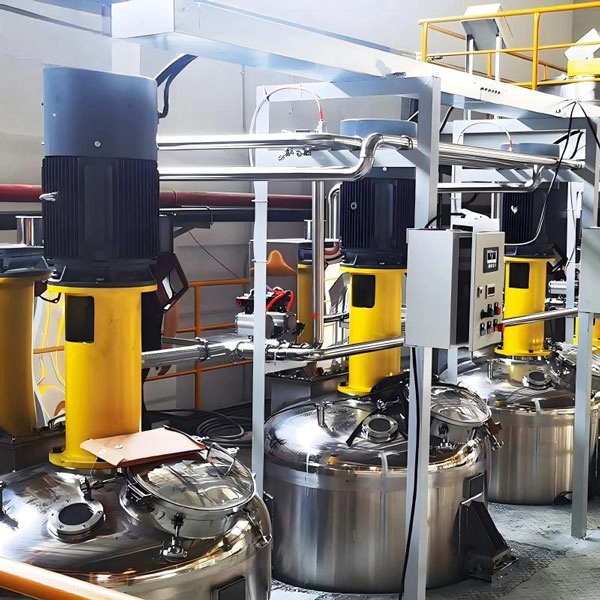
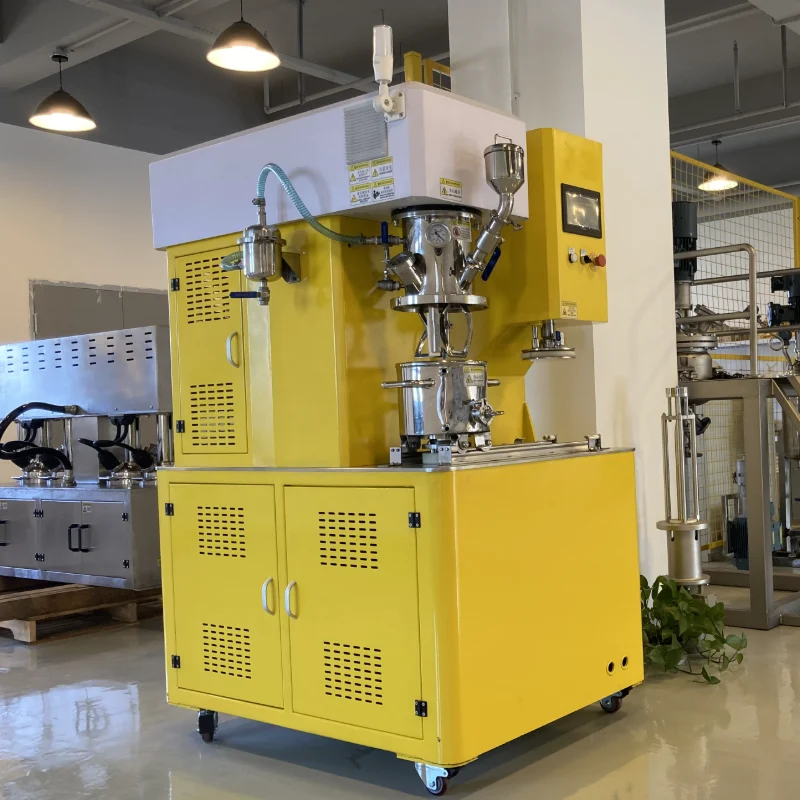
A battery slurry mixer typically combines a mixing vessel, planetary mixing system, independent dispersion system, scraper, vacuum system, temperature-control components, discharge mechanism, and PLC/HMI controls. Each part has a specific influence on slurry processing.
Planetary mixing is particularly useful when slurry viscosity and solid loading increase. Instead of relying on a single agitator to move material around a fixed axis, the planetary mixing elements travel through different areas of the vessel. This promotes repeated material circulation and reduces stagnant regions.
The scraper also plays an important role. Material adhering to the vessel wall can otherwise remain outside the main mixing zone. A properly designed scraper continuously returns this material toward the active mixing region, helping maintain a more consistent composition throughout the batch.
For cathode and anode slurries, this circulation becomes increasingly important as solid content and viscosity increase. The appropriate mixer therefore depends on more than nominal vessel volume. Effective working capacity, rheology, powder loading, and circulation characteristics all need to be considered.
Planetary movement provides bulk circulation, but it does not automatically provide sufficient localized shear for every formulation. This is why many battery slurry mixing machines combine planetary mixing with an independent high-speed dispersion system.
The dispersion unit generates a concentrated shear field that helps break down powder agglomerates and distribute conductive agents more evenly. This is particularly relevant for formulations where fine conductive powders tend to form clusters or where active material needs more intensive wetting.
The objective is not simply to maximize dispersion speed. Excessive speed can increase temperature, introduce unnecessary mechanical stress, or complicate viscosity control. The useful parameter is the combination of dispersion speed, shear intensity, mixing time, temperature and material circulation.
A higher rotational speed can increase shear and shorten the time required for certain dispersion stages, but slurry preparation is a balance between several variables.
If the speed is too low, agglomerates may remain. If it is too high for the formulation, temperature can rise and the slurry may experience undesirable rheological changes. Longer mixing can improve uniformity in some stages, but excessive processing can increase energy consumption and production time.
This is why the mixing recipe should normally define different operating conditions for different stages rather than applying one constant speed throughout the entire batch.
The addition sequence is also important. A typical process may involve dry blending or pre-dispersion, wetting, kneading, intensive dispersion, vacuum treatment, and final viscosity adjustment. The exact sequence depends on the electrode chemistry and binder system, but the underlying principle remains the same: each component needs to enter an environment where it can be properly wetted and dispersed.
Air can become entrained during powder addition, high-speed dispersion and intensive circulation. If these bubbles remain in the finished slurry, they can interfere with coating stability and may contribute to surface defects or inconsistencies during electrode manufacturing.
A vacuum system allows the mixer to reduce pressure inside the vessel during an appropriate stage of the process. Lower pressure encourages entrained air and other trapped gases to leave the slurry.
Vacuum mixing is therefore not simply an additional feature. Its value depends on how the vacuum level, slurry viscosity, temperature and mixing condition are coordinated. Applying vacuum at the wrong stage, for example, may affect material behavior or make processing more difficult.
Battery slurry viscosity is affected by formulation and processing conditions rather than by mixer speed alone. Important variables include:
Solid content and powder characteristics
Binder concentration and distribution
Solvent content
Mixing and dispersion intensity
Mixing time
Temperature
Addition sequence
Vacuum conditions
For this reason, viscosity should be treated as a process-control target. A mixer with temperature control can help manage heat generated during prolonged or high-speed operation. Consistent mixing conditions also reduce the possibility of localized concentration differences that can cause batch-to-batch viscosity variation.
For manufacturers supplying electrodes to high-volume battery production, this consistency matters because slurry rheology influences coating behavior. Changes in viscosity can affect flow through the coating system, coating thickness, leveling behavior, and ultimately electrode uniformity.
The key process variables are closely connected:
Mixing Speed → Shear → Dispersion → Particle Distribution
Mixing Time → Wetting and Homogenization
Temperature → Viscosity and Rheological Behavior
Vacuum Degree → Entrained Air Removal
Material Circulation → Batch Uniformity
Changing one parameter can affect the others. For example, increasing dispersion speed may improve agglomerate breakdown but also increase heat generation. A higher temperature can reduce apparent viscosity temporarily while changing the conditions under which the slurry behaves during processing.
This is why a battery slurry mixing machine should be evaluated according to the complete process window rather than one maximum speed or motor-power figure.
For buyers searching for a Battery slurry mixer for sale, equipment price should be evaluated together with the intended process. Two mixers with similar vessel volumes can have very different practical capabilities because of differences in working capacity, mixing power, dispersion configuration, vacuum performance, control architecture, and discharge design.
Nominal vessel volume is not the same as effective working capacity. High-viscosity slurry needs sufficient free space for circulation and processing. Selecting equipment solely according to vessel volume can create problems if the actual batch requires more circulation space.
Laboratory equipment generally prioritizes flexible formulation development and small batch control. Pilot-scale systems need to reproduce important process conditions at a larger scale, while production equipment must maintain repeatability across frequent batches and integrate with the factory's production schedule.
The mixer should provide a usable operating range rather than simply a high maximum RPM. Buyers should compare planetary speed and independent dispersion speed separately and determine whether the available range matches the viscosity, solid content, and dispersion requirements of the formulation.
A suitable vacuum system should be evaluated by its controllable vacuum range, sealing configuration and ability to maintain the required processing conditions.
Temperature control is equally important when mixing generates significant heat. Maintaining a controlled slurry temperature helps keep viscosity and processing behavior more consistent.
PLC/HMI automation can record and manage variables such as mixing speed, dispersion speed, mixing time, temperature and vacuum conditions. This is particularly valuable when manufacturers need to reproduce the same recipe across multiple batches.
Material-contact surfaces should be selected according to the slurry chemistry, cleaning requirements, corrosion resistance and contamination-control requirements of the application.
Discharge design also becomes more important as viscosity increases. A system that works well with a relatively fluid slurry may not provide the same discharge behavior with a high-solid-content formulation.
Maintenance access, scraper replacement, sealing components, cleaning procedures and dispersion-unit servicing should therefore be considered during equipment selection. A lower initial equipment price does not necessarily mean lower total operating cost if cleaning and maintenance become more demanding.
There is no single mixer configuration that is automatically suitable for every cathode or anode formulation. The appropriate design depends on material characteristics, solid content, viscosity range, batch size, required dispersion intensity, vacuum requirements, temperature sensitivity and production scale.
A planetary mixer with independent high-speed dispersion is often considered when the process requires both strong bulk circulation and localized shear. However, the final configuration should be established from the actual slurry formulation and required process window rather than from equipment type alone.
When comparing a battery slurry mixing machine, buyers should ask how the machine will reproduce the required mixing recipe—not simply how powerful the motor is.
The purchase price of a battery slurry mixer can vary significantly because equipment configuration determines much of its cost. Working capacity, motor power, dispersion system, vacuum equipment, temperature-control system, vessel construction, automation level and discharge configuration can all affect the quotation.
The better purchasing approach is to compare the complete process requirement: batch size, slurry viscosity, solid content, required mixing time, vacuum operation, cleaning frequency, maintenance requirements, energy consumption and future production expansion.
For RUMI Technology, this process-oriented approach is central to equipment development. Since launching its first self-developed high-precision dosing system and high-efficiency mixing equipment in 2018, RUMI has focused on fine chemical equipment and customized mixing and dosing solutions. Its experience covers applications including resins, new materials, coatings, inks, composites and new-energy industries.
RUMI Technology has developed its equipment through hundreds of R&D iterations and established a quality assurance process that includes 72-hour factory testing and 24-hour after-sales response. The company holds ISO9001 and CE certifications and serves customers internationally with equipment, quality control and technical service designed around long-term cooperation.
For battery manufacturers and material companies, this means the mixer should be evaluated as part of the slurry preparation process rather than as an isolated piece of machinery. The most relevant questions are whether the equipment can provide the required dispersion force, circulation pattern, vacuum control, temperature management and repeatable operating parameters for the intended formulation.
Ultimately, the right Battery Slurry Mixer for Sale is the configuration that matches the slurry's rheology and production requirements while maintaining consistent processing conditions from one batch to the next. That consistency is what connects mixing equipment performance with stable electrode coating and more controlled battery manufacturing.