 en
en  vi
vi  it
it  es
es  tr
tr  ja
ja  pt
pt  nl
nl  ru
ru  fr
fr  de
de  pl
pl  ar
ar News
Latest news and events.



In industrial fluid handling, moving a liquid from one point to another is not the same as controlling how much liquid enters the process. A conventional transfer pump may deliver the required volume under one operating condition, but changes in discharge pressure, viscosity, temperature or suction conditions can cause the actual flow to shift. For chemical dosing, formulation, pharmaceutical production, food processing and water treatment, this variation can affect product composition, treatment efficiency and process repeatability.
A properly specified Liquid Metering Equipment system is designed around the required flow rather than simply the ability to transport liquid. The objective is to deliver a defined quantity repeatedly under actual process conditions. That requires matching the metering device, wetted materials, pressure rating and control method to the liquid and the process.
A Liquid Metering Device is equipment designed to measure, regulate or deliver a controlled quantity of liquid at a specified flow rate. Depending on the application, the system may use a positive-displacement metering pump, flow meter, variable-speed pump, control valve, sensor or a combination of these components.
For dosing applications, positive-displacement metering pumps are commonly selected because their delivered volume is related to displacement and operating frequency. Capacity can then be adjusted through stroke length, pump speed or both. This makes them suitable for low-flow dosing and applications where a controlled feed rate is required.
However, the pump alone does not determine the accuracy of the complete system. Pressure, viscosity, temperature, suction conditions, calibration and control strategy can all affect the delivered flow. This is why liquid metering should be treated as a system-design problem rather than a simple pump-selection exercise.
The first step is to define the complete operating range. Buyers should provide minimum, normal and maximum flow, rather than specifying only the maximum capacity.
For example, a process requiring 10 L/h during normal production but occasionally increasing to 50 L/h has very different requirements from a process that continuously operates around 45–50 L/h. If the selected pump is excessively oversized, the normal operating point may fall near the lower end of its controllable range, where flow adjustment and repeatability can become more difficult.
Turndown ratio is therefore an important selection parameter. It describes the usable relationship between maximum and minimum flow within the specified performance range. A 10:1 turndown, for example, indicates a controllable range from 100% down to 10% of rated capacity under the stated performance conditions.
Accuracy and repeatability should also be evaluated separately. Accuracy describes how closely the delivered flow matches the required setpoint, while repeatability concerns the ability to produce substantially the same result when operating conditions and settings are repeated. These figures are meaningful only when the test conditions and operating range are clearly defined.
Pressure is another critical factor. A metering pump that performs correctly at a stable discharge pressure may behave differently when downstream pressure changes significantly. The complete system should therefore consider the pump's pressure rating, piping resistance, back-pressure conditions and any pressure-control components.
Liquid properties are equally important. Higher viscosity can change suction behavior, valve response and volumetric efficiency, particularly when the equipment was originally selected around low-viscosity liquids. Temperature can also change viscosity and density, meaning that a process handling a heated resin or concentrated chemical may require different sizing from the same liquid at ambient temperature.
For corrosive media, the wetted parts must be selected according to actual chemical compatibility. Depending on concentration, temperature and exposure conditions, materials may include stainless steel, engineered plastics, elastomers or specialized alloys. The material decision should be based on the complete chemical environment rather than simply the chemical name.
There is no single metering principle suitable for every application.
For chemical dosing, a diaphragm or piston-based positive-displacement metering pump can be appropriate when the process requires controlled low flow against relatively high pressure. These systems are widely used for acids, alkalis, treatment chemicals and other process fluids where controlled dosing is more important than simple liquid transfer.
For pharmaceutical and formulation processes, the selection may place greater emphasis on repeatability, material compatibility, cleanability and controlled flow. The pump and flow measurement arrangement must be considered together with the production process and sanitation requirements.
For food and beverage production, product viscosity, temperature, hygiene requirements and shear sensitivity can become important. A device selected only from a nominal flow-rate table may not perform as expected if the liquid becomes significantly thicker at lower temperatures.
For water treatment, chemical feed rates may change according to plant load or measured water quality. A manually adjusted pump may be adequate for a simple fixed-dose application, while a process requiring continuous adjustment may use a 4–20 mA signal, pulse input, VFD or PLC-based control.
A flow meter becomes particularly valuable when the process needs confirmation of actual delivery. Instead of assuming that pump speed equals flow, the system can measure the downstream flow and use that signal for correction. In a closed-loop arrangement, the metering pump provides the controlled flow source while the flow meter provides feedback. The PLC or controller can then adjust pump speed or capacity according to the measured deviation. Industrial metering guidance similarly emphasizes that accurate flow control depends on combining the pump, measurement method and control strategy.
Manual stroke or speed adjustment can be suitable for processes with a relatively constant production rate. It is simple and does not require a complete control architecture.
When process conditions change, electronic control becomes more useful. A 4–20 mA signal can allow the metering device to follow an external process variable. Pulse control can synchronize dosing with another piece of equipment or a measured flow signal. A VFD can adjust motor speed, while a PLC can coordinate pump operation with valves, sensors, alarms and other production equipment.
The correct choice depends on the process response time and required control range. Automation should not be added simply because it is available; it should solve a defined control problem.
Liquid Metering Equipment Price can vary considerably because the equipment specification changes with the application.
The metering principle is one of the first factors. A basic pump with manual adjustment has a different cost structure from a complete skid incorporating a metering pump, flow meter, pressure sensors, PLC and communication interfaces.
Flow and pressure requirements also affect the equipment configuration. Higher pressure may require stronger liquid-end components, seals and drive arrangements. Extremely low flow may require a smaller displacement or a control system capable of maintaining performance at low capacity.
Materials are another major cost factor. Standard materials may be suitable for water or compatible chemicals, while corrosive, high-temperature or aggressive liquids may require specialized wetted materials and sealing components.
Control requirements can further increase the initial investment. Manual adjustment, electronic stroke control, VFD operation and PLC-based closed-loop control represent different levels of system integration. Additional sensors and communication interfaces can increase both hardware and engineering costs.
Customization also matters. A standard catalog unit generally has a different price structure from a system designed around a specific flow range, pressure profile, liquid viscosity, material requirement and automation architecture.
More importantly, purchase price should not be evaluated separately from lifecycle cost. Incorrect sizing can increase calibration work, diaphragm or seal replacement, energy consumption and process losses. A properly selected system may have a higher initial price while reducing operating interruptions and maintenance requirements over its service life.
A practical comparison should begin with the actual process data:
Minimum, normal and maximum flow
Required accuracy and repeatability
Operating and maximum pressure
Liquid viscosity and density
Minimum and maximum temperature
Chemical composition and corrosiveness
Required wetted materials
Required turndown ratio
Manual or automatic control
4–20 mA, pulse, VFD or PLC requirements
Flow-meter feedback requirements
Calibration and maintenance requirements
This specification gives suppliers enough information to recommend a device based on the real process instead of simply quoting a pump with the required maximum flow.
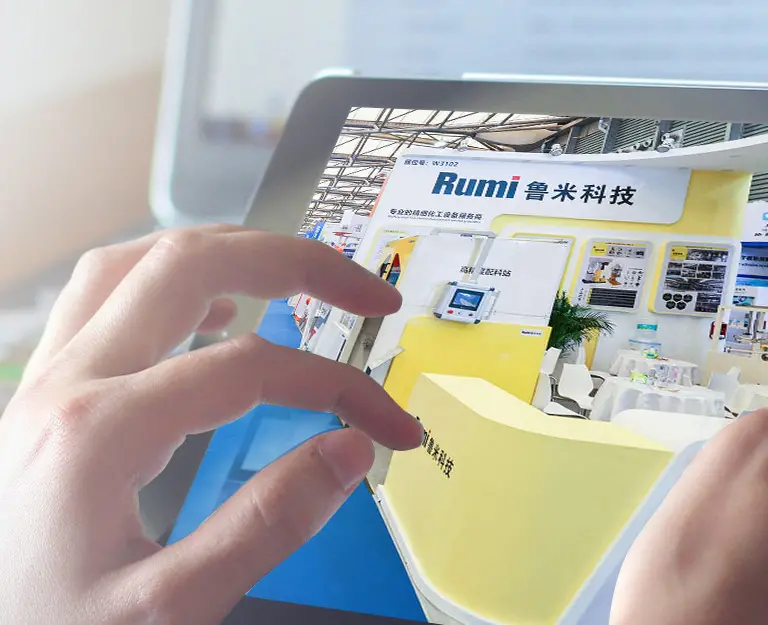
RUMI Technology approaches liquid metering from the perspective of the complete chemical process. Since launching its first self-developed high-precision dosing system and high-efficiency mixing equipment in 2018, RUMI has focused on serving as a professional fine chemical equipment service provider.
Its experience covers customized dosing requirements for paint and ink manufacturers, mixing systems for resin and new-material companies, and system solutions for new energy and composite-material applications. Rather than treating flow capacity as the only specification, RUMI Technology develops solutions around the required dosing accuracy, liquid characteristics, equipment configuration and process conditions.
The company has established a quality assurance system that includes 72-hour factory testing and 24-hour after-sales response, with ISO9001 and CE certifications. Its broader focus remains the development of mixing and dosing technology for customers requiring integrated fine chemical equipment solutions.
For buyers comparing Liquid Metering Equipment Price, the key question is therefore not simply which quotation has the lowest initial figure. The more useful comparison is whether the selected Liquid Metering Device can maintain the required flow range, pressure capability, repeatability and material compatibility under the actual process conditions—and whether the control and maintenance configuration will remain practical throughout the equipment's operating life.