 en
en  vi
vi  it
it  es
es  tr
tr  ja
ja  pt
pt  nl
nl  ru
ru  fr
fr  de
de  pl
pl  ar
ar News
Latest news and events.



High-viscosity materials place very different demands on mixing equipment than low-viscosity liquids. Conventional agitators can struggle to generate sufficient circulation when the material becomes thick, leaving unmixed zones, poor powder dispersion and material stuck against the vessel wall. Air can also become trapped during mixing, while exposure to oxygen may affect materials that are sensitive to oxidation or unwanted reactions.
For manufacturers of adhesives, sealants, lithium battery slurries, silicone products, resins and ceramic pastes, the issue is not simply whether a mixer can move the material. The equipment must create controlled material circulation, provide sufficient shear, remove material from the vessel wall, manage temperature and, when required, maintain a vacuum throughout the process. A vacuum planetary mixer combines these functions in one processing system.
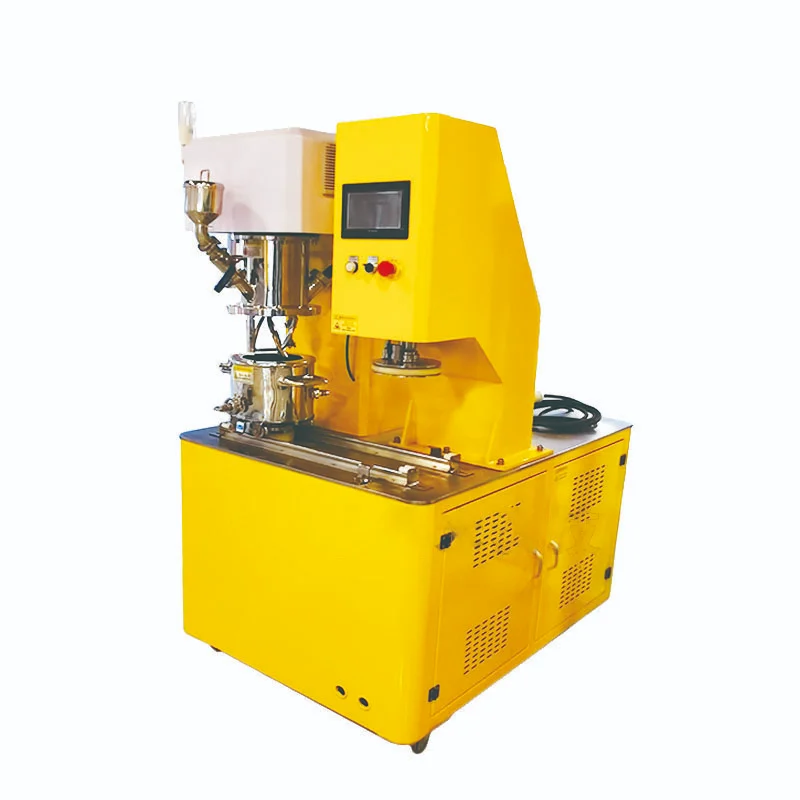
The main difference between a planetary mixer and a conventional agitator is the movement of the mixing tools. In a planetary configuration, the double planetary paddles rotate around their own shafts while continuously revolving around the center of the mixing vessel. This creates a broader working path through the material rather than relying on a single rotating zone.
The high-speed disperser provides a different type of mechanical action. While the planetary paddles move and circulate the bulk material, the dispersing disc generates higher local shear for breaking down agglomerates, wetting powders and improving the distribution of fillers or pigments. The planetary paddles also push material toward the area of the high-speed disperser, allowing the two mechanisms to work together rather than operating as independent mixing tools.
The PTFE wall scraper addresses another common problem with high-viscosity compounds: material remaining on the vessel wall. As the mixing assembly revolves, the scraper continuously sweeps material away from the internal wall and returns it to the active mixing zone. This reduces stagnant material layers and also helps expose more of the batch to the heated or cooled vessel surface.
This combination is particularly useful for putty, silicone gel, lithium battery slurry, solder paste, ceramic paste, sealants and structural adhesives. Toothpaste and soft creams can also benefit from the same processing principle when the formulation requires intensive bulk mixing combined with controlled dispersion.
For buyers asking what type of planetary mixer is suitable for high-viscosity materials, the key consideration is therefore not the mixer name alone. The paddle configuration, disperser speed, scraper design, motor torque, working volume and material characteristics need to be evaluated together.
A conventional mixer may use one primary impeller to move the batch. A planetary system instead combines bulk circulation, localized high-shear dispersion and wall cleaning. For difficult formulations, that difference can directly affect batch uniformity and processing time.
High-viscosity materials can retain air for much longer than low-viscosity liquids. Once bubbles are dispersed throughout a thick compound, gravity alone may not remove them effectively. This is particularly important for adhesives, sealants, electronic compounds and other products where voids can affect application or final performance.
A vacuum planetary mixing machine allows the vessel to remain under vacuum during the mixing process. Lowering the pressure helps entrained air expand and escape from the compound instead of remaining as microscopic bubbles throughout the batch. The sealed environment can also reduce unnecessary contact between the material and atmospheric oxygen, which is useful for formulations that are sensitive to oxidation or other air-related reactions.
Vacuum performance should not be evaluated only by the nominal vacuum value. Buyers should also consider whether the vessel, shaft seals and vacuum piping can maintain stable vacuum conditions during actual mixing. The behavior of the material itself is equally important because different viscosities and formulations release entrained air at different rates.
Temperature control is another important part of high-viscosity processing. As viscosity changes with temperature, heating can make a compound easier to circulate and disperse, while cooling may be necessary to protect temperature-sensitive ingredients or control the final product condition.
A jacketed vessel can circulate a heating or cooling medium according to the formulation and process requirements. For procurement teams, the relevant questions include the required temperature range, heating or cooling medium, heat-transfer requirements, temperature sensor location and PLC control strategy rather than simply asking whether the machine has a heating jacket.
RUMI Technology designs mixing and dosing equipment around these process requirements. Since developing its first self-developed high-precision dosing system and high-efficiency mixing equipment in 2018, RUMI has focused on fine chemical equipment and customized solutions for industries including resins, new materials, new energy and composites. Its quality system includes 72-hour factory testing and a 24-hour after-sales response, supported by ISO9001 and CE certifications.
When comparing vacuum planetary mixing machine price, capacity is an important factor, but it is only one part of the equipment configuration. Two machines with the same nominal volume can have substantially different prices because their mixing systems, vacuum equipment, automation and materials are different.
Capacity ranges from approximately 30L to 2000L allow the equipment to cover different production stages. A 30L-class machine may be more appropriate for laboratory development, formulation trials or small-batch production. Larger 100L–500L systems can fit pilot and regular production requirements, while machines approaching 1000L–2000L are more relevant to larger manufacturing operations. The actual selection should be based on required batch size and effective working volume rather than vessel volume alone.
The mixing configuration is another major price factor. A system combining double planetary paddles, a high-speed disperser and PTFE wall scraper requires more mechanical components and drive capacity than a basic planetary mixer. Motor power and frequency-converter control should also match the viscosity and batch characteristics.
Contact material affects both price and chemical compatibility. SUS304 is suitable for many general applications, while SUS316L may be preferable when the formulation or cleaning process requires greater corrosion resistance. The correct choice should be made according to the actual chemical environment rather than selecting stainless steel solely as a specification item.
Other cost-driving configurations include the vacuum system, hydraulic lifting mechanism, jacketed heating/cooling system, PLC touch-screen control and safety interlocks. Hydraulic lifting can simplify vessel or mixing-head positioning, while safety limit switches can prevent operation when the vessel or agitators are not correctly positioned.
For this reason, a low initial quotation does not necessarily represent a lower total equipment cost. Procurement teams should compare the complete technical configuration, expected production duty and long-term maintenance requirements.
When selecting a Vacuum Planetary Mixing Machine manufacturer, buyers should look beyond catalog specifications. The manufacturer should be able to match the mixing structure and drive system to the actual viscosity, solids content, batch volume and temperature requirements of the formulation.
Manufacturing experience with high-viscosity materials is particularly valuable because mechanical design becomes more demanding as resistance to mixing increases. Shaft stability, sealing, motor selection, scraper clearance, vacuum retention and vessel construction all influence long-term operation.
RUMI Technology has developed its mixing technology through hundreds of R&D iterations and focuses on customized equipment for fine chemical applications. Its product range supports capacities from 30L to 2000L, with options including SUS304 or SUS316L contact materials, PLC touch-screen control, adjustable speed, hydraulic lifting, vacuum processing and jacketed heating or cooling.
The right manufacturer should also be capable of adjusting the machine to the production process rather than forcing every customer into one standard configuration. For a new lithium battery slurry line, for example, dispersion requirements may dominate the specification. For a sealant or structural adhesive producer, vacuum deaeration, temperature control and wall cleaning may carry greater importance.
Ultimately, the best equipment is the one whose mechanical configuration matches the material and production cycle. Vacuum planetary mixing machines should therefore be evaluated as complete processing systems rather than as simple mixing vessels.
For high-viscosity material manufacturers, vacuum planetary mixing machine price is only one part of the purchasing decision. Mixing structure, dispersion capability, vacuum deaeration, temperature control, wall scraping, contact materials, automation, vessel capacity and the manufacturer's engineering capability all influence the actual value of the equipment. A properly configured machine can provide more consistent circulation, dispersion and deaeration while supporting repeatable production across demanding formulations. The right choice begins with understanding the process requirements and then selecting a Vacuum Planetary Mixing Machine configuration that is engineered around them.