 en
en  vi
vi  it
it  es
es  tr
tr  ja
ja  pt
pt  nl
nl  ru
ru  fr
fr  de
de  pl
pl  ar
ar News
Latest news and events.




In modern fine chemical and materials manufacturing, the Best industrial double shaft mixer is no longer simply defined as a mechanical agitation device. It should be understood as a controlled flow field engineering system designed to manage shear distribution, circulation dynamics, and particle dispersion behavior within high-viscosity and multi-phase materials. The performance of such equipment directly determines whether a formulation can achieve stable rheological properties, uniform particle distribution, and repeatable batch quality in industrial-scale production environments.
For process engineers and procurement decision-makers, the evaluation standard has shifted significantly. Instead of focusing only on tank volume or rotational speed, the real technical concern lies in torque stability under variable load, consistency of shear field distribution across the vessel volume, and the ability to maintain stable mixing performance under continuous industrial operation. These factors become especially critical in systems involving coatings, resins, adhesives, and lithium battery slurries where even minor inconsistencies in dispersion can lead to batch rejection or performance degradation.
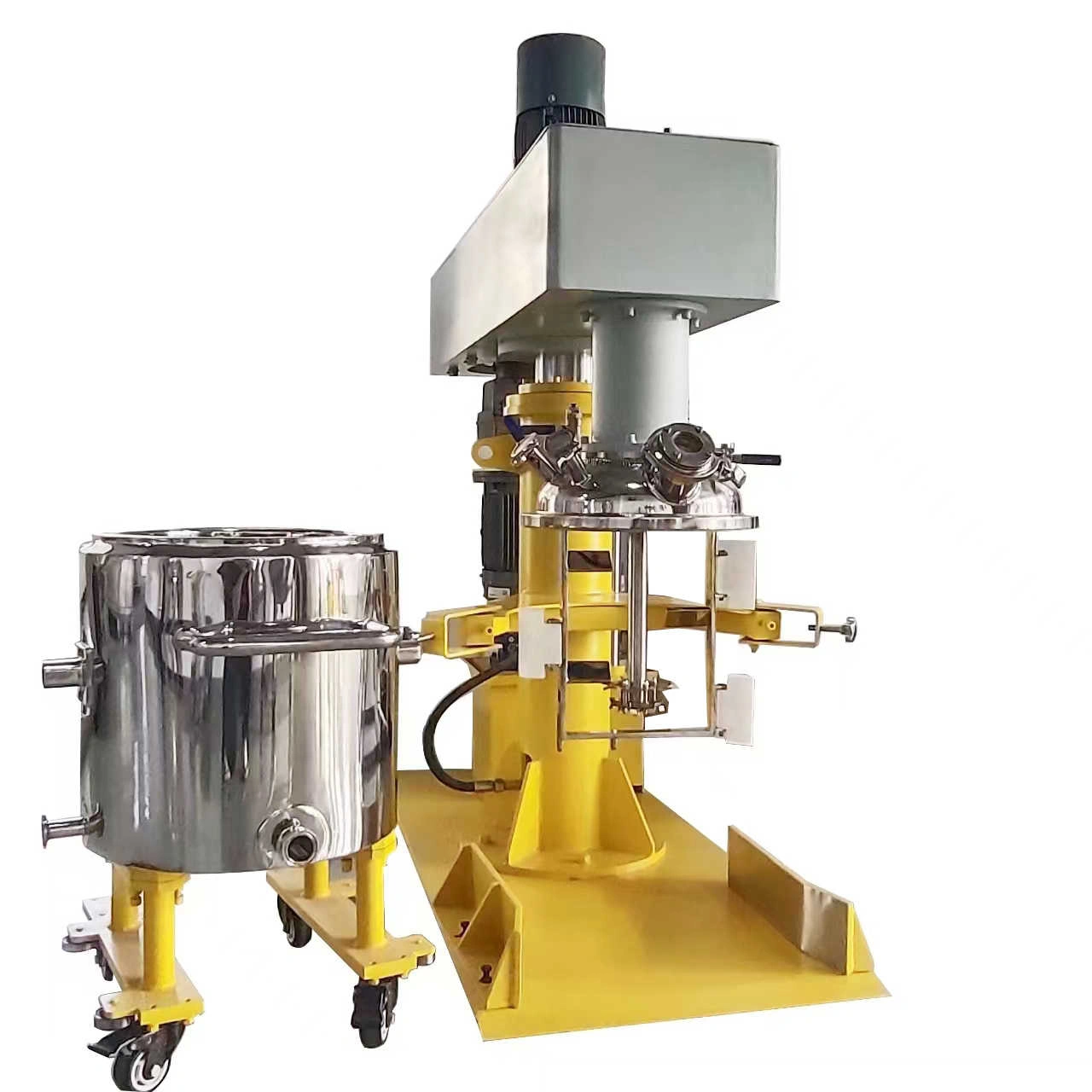
The core technological foundation of the Best industrial double shaft mixer lies in its Dual-Shaft Independent Drive Mixing Architecture, which physically separates macro-scale circulation and micro-scale dispersion into two independently controlled mechanical systems. This separation allows the mixer to generate a stable hydrodynamic environment where both bulk flow and localized shear can be optimized simultaneously without interfering with each other’s functional efficiency.
High-speed dispersing shaft for controlled micro-particle fragmentation
The central high-speed dispersing shaft operates at a precisely controlled linear tip velocity to generate intense localized shear fields within the material. This shear field is responsible for breaking down agglomerated powder clusters, accelerating wetting behavior, and promoting uniform particle separation at the microscopic level. Unlike single-shaft systems where shear distribution is uneven and localized, this design ensures that dispersion energy is consistently applied across the active mixing zone, significantly improving particle size uniformity and dissolution efficiency in high-viscosity systems.
Low-speed anchor shaft for continuous macro-scale circulation control
The outer anchor agitator is engineered to maintain a stable and continuous circulation loop throughout the entire vessel volume. Its primary function is not only to prevent material stagnation but also to actively transport unmixed or partially mixed material into the high-shear zone for further processing. This continuous circulation mechanism eliminates dead zones and ensures that every portion of the batch experiences uniform mixing conditions, which is critical for maintaining batch-to-batch consistency in industrial production.
PTFE scraper system for boundary layer renewal and thermal control
The wall-mounted PTFE scraper continuously removes material adhered to the internal vessel surface, ensuring that no stagnant boundary layers are formed during operation. This function is essential for preventing localized overheating and material degradation, especially in high-viscosity formulations where heat dissipation is naturally slower. By continuously renewing the boundary layer, the system improves thermal uniformity and ensures that all material remains actively involved in the mixing process.
A key innovation implemented by advanced Industrial double shaft mixer manufacturers is the Dual Dynamic Coupled Shear System, which synchronizes high-speed dispersion and low-speed circulation into a coordinated mixing mechanism. This coupling is not merely mechanical but hydrodynamic in nature, ensuring that energy input is distributed efficiently across both micro and macro mixing scales.
High-intensity shear zone for agglomerate destruction and particle deconstruction
Within the dispersing zone, material is subjected to high velocity gradients that generate significant shear stress, which is essential for breaking down particle agglomerates into primary particle states. This process is particularly important in pigment dispersion, resin emulsification, and slurry preparation, where particle size distribution directly affects final product performance. The system ensures that shear energy is applied in a controlled manner to avoid over-shearing, which could otherwise lead to material degradation or instability.
Stable circulation loop ensuring homogeneous spatial redistribution
After particles are broken down in the high-shear zone, the anchor-driven circulation system ensures their immediate redistribution throughout the entire mixing volume. This prevents localized concentration gradients and guarantees that newly dispersed particles are evenly distributed within the matrix, maintaining long-term suspension stability and preventing sedimentation or phase separation.
Thermal load balancing to prevent localized overheating in viscous systems
In high-viscosity materials, energy input often converts into heat due to internal friction. Without proper circulation, this can result in thermal hotspots that degrade sensitive chemical structures. The coupled system distributes mechanical energy more evenly across the entire vessel, ensuring that heat generation remains uniform and manageable under industrial operating conditions.
A frequently asked technical question is what types of materials are best suited for a Best industrial double shaft mixer. The answer is fundamentally determined by the rheological characteristics of the material system and its response to shear forces under controlled mixing conditions.
High solid-content systems requiring controlled shear penetration
Materials such as coatings, adhesives, and pigment-rich slurries exhibit complex non-Newtonian behavior, where viscosity changes dynamically under applied shear. Dual-shaft systems allow precise control over shear intensity, ensuring that material transitions remain stable without causing structural breakdown or phase instability during processing.
Thixotropic systems requiring continuous structural regeneration
Many industrial pastes exhibit time-dependent viscosity behavior, meaning they become less viscous under agitation and recover viscosity when static. The anchor-driven circulation system ensures that this structural behavior remains controlled and consistent throughout processing, preventing localized collapse or uneven viscosity distribution.
Multi-phase systems requiring simultaneous dispersion and homogenization
In systems containing solid, liquid, and additive phases, uniform integration requires both macro-scale blending and micro-scale dispersion to occur simultaneously. The dual-shaft architecture ensures that both processes are continuously active, eliminating phase separation risks and improving formulation stability.
From a fluid mechanics perspective, the performance of industrial mixing systems is governed by Reynolds number behavior, shear rate distribution, and flow regime stability within the vessel.
Reynolds number control for hybrid laminar–turbulent mixing regimes
High-viscosity materials typically operate in low Reynolds number regimes where laminar flow dominates. However, the introduction of localized high-speed dispersion zones creates controlled turbulence within an otherwise laminar system. This hybrid flow regime significantly enhances particle interaction frequency without destabilizing the overall system flow structure.
Shear rate distribution and energy transfer efficiency optimization
The dispersing impeller generates localized high shear zones where particle size reduction occurs. The key engineering challenge is ensuring that this shear is neither too localized nor too broadly distributed. Proper design ensures optimal energy transfer efficiency, maximizing dispersion effectiveness while minimizing unnecessary energy consumption.
Elimination of stagnation zones through geometric flow engineering
The combination of anchor geometry and scraper design ensures that no region within the vessel remains hydraulically inactive. All material is continuously cycled through active mixing zones, eliminating dead zones that would otherwise reduce process efficiency and increase batch inconsistency.
RUMI Technology, a professional chemical equipment manufacturer, has developed industrial mixing systems based on long-term engineering research in fine chemical processing applications. Since 2018, RUMI has focused on high-efficiency mixing systems and precision dosing technologies used in coatings, inks, resins, and new energy materials industries.
The structural design of its double shaft mixers includes multiple industrial-grade engineering features:
Independent concentric shaft drive system ensuring stable torque distribution under variable load conditions, preventing mechanical interference between high-speed and low-speed mixing components
Hydraulic lifting mechanism designed for stable vertical motion control, enabling safe maintenance access and improving operational efficiency in production environments
Frequency inverter control system enabling precise speed adjustment for both shafts, allowing real-time adaptation to different material rheological conditions
Jacketed vessel design supporting thermal regulation through heating or cooling media, ensuring process temperature stability during exothermic or temperature-sensitive reactions
Stainless steel 304 wetted components with optional SS316L upgrade for corrosive or high-purity chemical environments
Vacuum and inert gas sealing capability enabling oxygen-sensitive or volatile material processing under controlled atmospheric conditions
These structural and functional integrations ensure that the system maintains stable performance even under continuous industrial operation.
In long-term industrial applications, reliability is determined not only by mixing performance but also by mechanical durability and maintenance efficiency.
Advanced sealing system design reducing leakage risk under high-viscosity and high-pressure conditions, ensuring continuous operation without process contamination or material loss
Reinforced bearing and shaft support structures improving torque transmission stability and preventing misalignment under long-term continuous load cycles
Hydraulic lifting system enabling rapid maintenance access, significantly reducing downtime during cleaning, inspection, or component replacement procedures
These engineering enhancements collectively extend equipment service life and improve production line availability in continuous manufacturing environments.
The Best industrial double shaft mixer represents a fully engineered hydrodynamic system designed to control shear distribution, circulation stability, and dispersion kinetics in high-viscosity industrial materials.
Through dual-shaft independent drive architecture, coupled shear systems, and reinforced mechanical structures, these systems achieve stable particle dispersion, consistent batch quality, and high-efficiency industrial-scale production performance.
For modern chemical manufacturing industries, selecting a mixing system is not simply an equipment choice—it is a decision about how effectively fluid dynamics, energy transfer, and material transformation are controlled at industrial scale.