 en
en  vi
vi  it
it  es
es  tr
tr  ja
ja  pt
pt  nl
nl  ru
ru  fr
fr  de
de  pl
pl  ar
ar News
Latest news and events.



When processing medium- to high-viscosity materials, a conventional single-shaft mixer may not provide enough material circulation or dispersion. As viscosity increases, the material becomes less mobile, making it harder for the entire batch to move through the mixing zone. At the same time, powders or additives may require stronger shear for dispersion, while material close to the tank wall can move more slowly and remain attached to the surface.
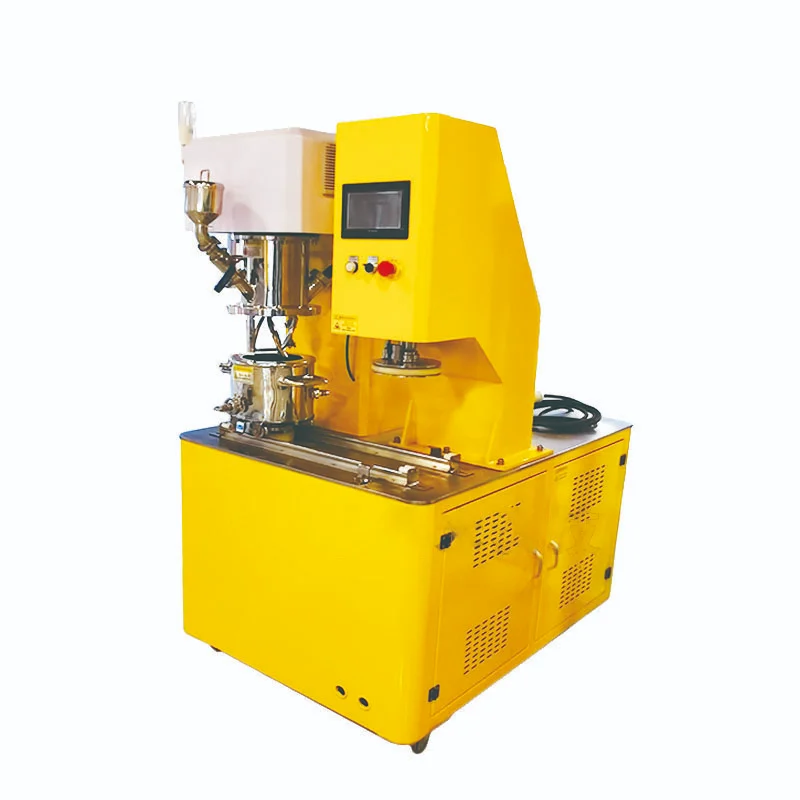
A chemical triple shaft mixer addresses these different process requirements by combining independently driven mixing mechanisms in one vessel. Instead of relying on one agitator to perform every task, the machine can use a high-speed disperser for dispersion, a helical or anchor-type agitator for bulk circulation, and an anchor blade with wall scraper for continuous wall contact. This configuration makes triple shaft mixers particularly useful for chemical formulations where viscosity, dispersion, heat transfer and material uniformity must be controlled together.
The basic principle is to use three independently driven agitators with different mechanical functions. Each shaft can be configured according to the formulation and production process rather than forcing one blade to handle all mixing operations.
A high-speed disperser creates stronger localized shear and turbulence around the dispersing disc. It is useful when pigments, fillers or other solid components need to be incorporated into a liquid or viscous phase. For printing inks, for example, the disperser can support pigment wetting and dispersion after the solids have entered the formulation.
A helical blade has a different role. Rather than concentrating primarily on localized high shear, it helps move viscous material through the vessel and supports overall blending. This becomes important when the formulation has poor natural flow and the material around the vessel must be brought into the main mixing zone.
An anchor blade with wall scraper works at lower mixing intensity while maintaining close contact with the tank wall. The scraper helps remove material from the wall and return it to the bulk mixture. This can also improve contact between the product and a jacketed tank surface when heating or cooling is part of the process.
The three shafts are independently driven, so the operating conditions of one agitator do not have to be identical to those of the others. A formulation may require stronger dispersion during one stage and greater bulk circulation or wall scraping during another. Independent drives provide the flexibility to adjust these functions separately.
This is one of the main reasons a triple shaft mixer can be more suitable than a simple single-agitator system for difficult, viscous formulations.
The answer depends on the material's viscosity, dispersion requirement, flow characteristics and temperature sensitivity. Triple shaft mixers are particularly relevant to formulations where blending alone is not enough.
Printing ink production can involve pigments, binders, solvents and additives that require both incorporation and dispersion. A high-speed disperser can provide the localized shear needed for pigment dispersion, while a helical or anchor agitator keeps the more viscous formulation circulating.
For these applications, a high-speed disperser + helical blade + anchor scraper arrangement can provide separate mechanisms for dispersion, bulk movement and wall scraping.
Sealants and adhesives often become difficult to move as viscosity increases. A conventional high-speed agitator may create a strong mixing zone but fail to move the entire batch effectively.
A helical or anchor-type agitator can support bulk circulation, while the high-speed disperser addresses components that require stronger shear. The wall scraper helps reduce the amount of material remaining against the vessel wall.
For formulations requiring stronger localized shear, a configuration combining a high-speed disperser + rotor/stator + anchor scraper can be considered. The rotor/stator provides another mechanism for intensive processing, while the anchor and scraper remain responsible for bulk movement and wall contact.
Hot melt adhesives introduce another consideration: temperature. The material must often remain within an appropriate processing condition to maintain workable flow.
A jacketed triple shaft mixer can provide a controlled surface for heating or cooling. The anchor scraper helps maintain contact between the material and the tank wall, while the other agitators perform their respective mixing functions.
The actual jacket design and operating conditions should be determined from the formulation and thermal requirements rather than selected only from the mixer size.
Magnetic media slurry may require careful dispersion of solid particles within a viscous carrier system. Here, the selection of dispersing equipment becomes particularly important.
A high-speed disperser can provide the necessary localized shear, while the anchor or helical agitator supports overall batch circulation. If the formulation requires more intensive homogenization, a high-speed disperser + rotor/stator + anchor scraper configuration may offer a more appropriate processing arrangement.
Personal-care and oral-care formulations can have significantly different rheological behavior from conventional low-viscosity liquids. Creams, lotions and toothpaste require controlled bulk movement, incorporation of ingredients and, depending on the formulation, homogenization.
The appropriate configuration depends on whether the primary challenge is bulk blending, dispersion or more intensive homogenization. This is why a triple shaft mixer should be selected according to the formulation rather than simply classified as a general-purpose mixer.
The key advantage is not simply having three shafts. It is the ability to assign different mechanical functions to different agitators.
For a high-viscosity formulation, the process may simultaneously require:
High-speed dispersion for powders, pigments or additives
Bulk circulation to move the viscous material through the vessel
Wall scraping to prevent material from remaining against the tank surface
Homogenization where a more intensive mixing mechanism is required
Temperature control when the material must be heated or cooled during processing
Trying to perform all of these tasks with one agitator can create compromises. A triple shaft system separates the functions and allows the process engineer to configure the equipment around the actual formulation.
Variable-frequency drive (VFD) control further supports this approach. Instead of treating mixing speed as a fixed machine specification, the operator can adjust shaft speed according to the processing stage and required mixing action.
A high-speed disperser may therefore be used for a dispersion stage, while the anchor or helical agitator maintains bulk movement. The exact operating sequence depends on the formulation and process design.
For industrial buyers, the manufacturer should be evaluated on engineering capability rather than equipment price alone.
First, examine whether the manufacturer can design the agitator configuration around the material. A supplier should be able to discuss why a formulation needs a high-speed disperser, helical blade, anchor scraper, rotor/stator or a combination of these mechanisms.
Second, confirm the availability of three independently driven agitators. Independent drive control is important because the required shear and circulation are not necessarily the same throughout the process.
Third, discuss material viscosity, batch size, shear requirement and temperature control before selecting the equipment. A credible manufacturer should use these factors to determine the tank, agitators and drive arrangement rather than simply recommending a standard model.
The same applies to vacuum and inert gas operation. Vacuum may be required when the process needs controlled deaeration, while inert gas protection can be relevant when the formulation or process requires a controlled atmosphere. The sealing system and vessel design must therefore be considered together with the intended operating condition.
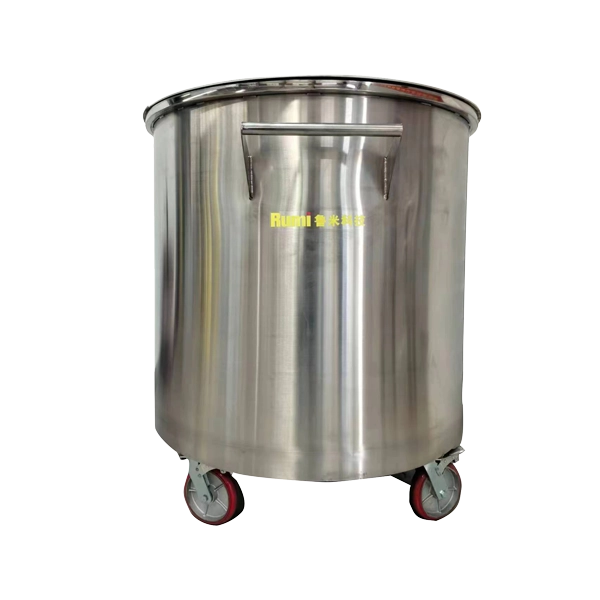
The wetted material is another important selection factor. Both SUS304 and 316L stainless steel can be used for chemical equipment, but the appropriate choice depends on the formulation's chemical compatibility, process conditions and cleaning requirements.
The manufacturer should evaluate the actual contact materials and chemical environment instead of selecting stainless steel purely on the basis of price.
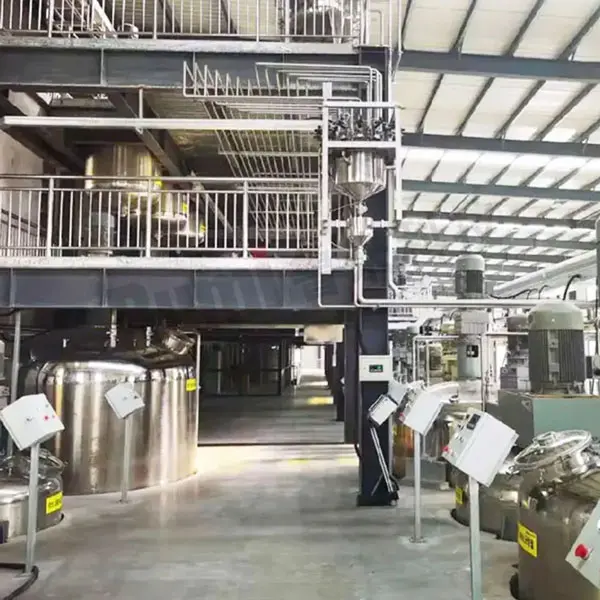
RUMI Technology is a professional supplier focused on chemical equipment and solutions, serving global customers with products, quality control and technical service designed for long-term industrial cooperation.
Since launching its first self-developed high-precision dosing system and high-efficiency mixing equipment in 2018, RUMI Technology has developed its position as a fine chemical equipment service provider. Its development has focused on mixing and dosing requirements across paints, inks, resins, new materials, new energy and composites.
For triple shaft mixing applications, this process-oriented approach is important because the correct equipment configuration depends on the relationship between material behavior and production requirements. RUMI can configure different combinations of high-speed dispersers, helical blades, anchor blades with scrapers and rotor/stator systems according to the intended process.
Its equipment can also be configured with independently driven agitators, VFD speed control, jacket heating or cooling, vacuum or inert gas operation, and SUS304 or 316L contact materials according to application requirements.
RUMI has established a quality assurance system that includes 72-hour factory testing and a 24-hour after-sales response, and the company holds ISO9001 and CE certifications.
For buyers evaluating Chemical triple shaft mixer manufacturers, the important question is therefore not simply, "How much does the mixer cost?" A more useful question is whether the manufacturer can translate material viscosity, dispersion requirements, shear demand, temperature control, atmosphere requirements and material compatibility into a workable equipment configuration.
A well-designed triple shaft mixer is ultimately a process solution. Its value comes from coordinating blade combination, independent drives, shear, wall scraping, speed control, heating or cooling, vacuum or inert gas protection and material compatibility around the formulation being produced.
That is what makes the technology relevant across chemical, ink, adhesive, sealant, magnetic slurry and personal-care manufacturing—and what separates a genuine engineering manufacturer from a supplier offering only a standard mixing vessel.